
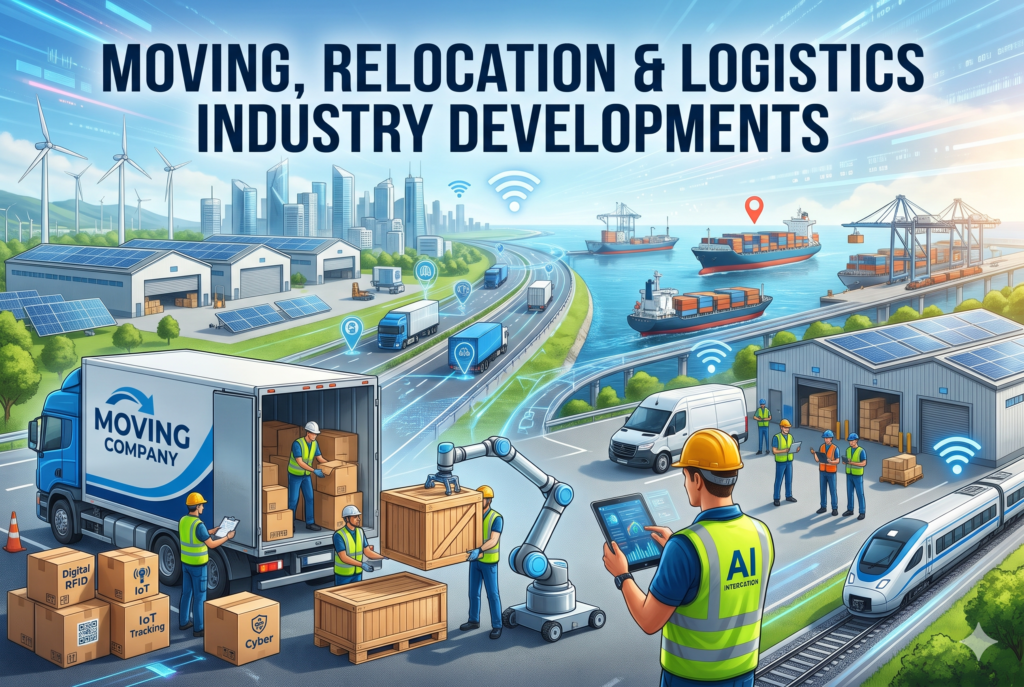
- Moving and relocation logistics in 2026 is shaped by rising operating costs, the spread of AI in dispatch and routing, and customer demand for live visibility.
- Movers are widening into storage and warehousing, so inventory accuracy now matters as much as truck capacity.
- Labor, compliance, fleet maintenance and sustainability are becoming operating issues, not side projects.
- The operators who benefit most connect their customer data, inventory and scheduling systems instead of adding isolated tools.
The moving and relocation logistics industry is moving from a trucks-and-crews business to a data-and-coordination business. Costs are rising, customers expect to see where their belongings are, and many movers now sell storage and corporate mobility services alongside the move itself. This briefing explains the main industry developments in 2026, why each is happening, who it affects, and what operators can do about it. Where a statement comes from a named industry source, it is attributed, and forecasts are labeled as forecasts.
1. Why the Moving Industry Is Changing Now
The first driver is cost. JK Moving Services, a US operator, describes rising costs across labor, vehicles, facilities and especially insurance as a significant issue for movers in 2026. When every cost line rises at once, small inefficiencies such as an empty half-truck, a missed delivery window or a lost inventory tag stop being tolerable.
The second driver is changing demand. Remote and hybrid work has changed what commercial moves look like, and international moves are pushing some providers toward specialization. Some regional commentary also expects pent-up residential demand to be released as housing conditions improve. That is a forecast, not a measured result, so operators should plan for it without staffing against it.
The third driver is a shift in what customers buy. They increasingly want a partner that can handle several services, not a single transaction. JK Moving lists warehousing among the adjacent services movers are adding.
| Driver | What is happening | Operational result |
|---|---|---|
| Cost pressure | Labor, vehicles, facilities and insurance costs are rising | Less tolerance for waste and idle capacity |
| Demand shifts | Hybrid work, international specialization, possible release of delayed moves | More varied job types and peaks |
| Service breadth | Movers add storage and related services | More inventory and handoff risk |
| Customer expectations | Demand for transparency in price and status | Need for live data, not phone calls |
2. AI and Predictive Logistics
Artificial intelligence is the most discussed development in moving logistics, and the most overstated. The practical question is where it is already useful.
DHL’s 2026 logistics outlook, as summarized by industry commentary, describes AI supporting routine decisions such as shipment rerouting, inventory planning and automated communication. The important shift is from reactive planning, where staff respond after something goes wrong, to predictive planning, where software flags likely problems early.
In use now
- Route and dispatch support: software that suggests routes and assignments based on distance, timing and vehicle capacity.
- Demand and workforce forecasting: estimating seasonal peaks so crews and equipment are scheduled before the rush, not during it.
- Customer messaging: automated status updates at job milestones.
- Inventory planning: supporting stock and storage decisions where goods are held between locations.
Still emerging
Autonomous vehicles and blockchain-based contract or data systems appear in many trend articles, but the evidence of routine use in moving is thin. Treat them as watch items, not purchases.
Limits to plan for: AI is only as good as the data behind it. If job records, inventory counts and customer details live in disconnected spreadsheets, predictions will be unreliable. Staff adoption and cost also matter. Connecting multi-agent AI for operational intelligence to clean operational data is more valuable than buying another standalone tool, and AI-driven ERP systems show how that connection works in larger organizations.
3. Digital Visibility: Tracking, Virtual Surveys and Online Quoting
Global Mobility Solutions identifies digitalization and real-time tracking as one of the most significant household goods shipment trends heading into 2026, with movers shifting from manual, paper-based processes to cloud-based platforms that give transparency through the relocation journey.
For operators, visibility has four practical parts:
- Live job tracking: milestone updates from pickup to delivery, replacing a single “crew is on the way” message.
- Virtual surveys: remote walk-throughs that estimate volume without a site visit.
- Online quoting: faster, more consistent estimates that reduce disputes about scope.
- Digital records: inventory lists, signatures and claims notes stored in one place, not in paper files.
The strategic point is that visibility tools only help when the data behind them is shared. A tracking app that is not connected to the customer record forces staff to re-enter information and answer the same questions twice. A CRM and automation setup built around your actual workflow and client journey automation are the usual ways service businesses connect booking, status updates and follow-up without adding headcount.
4. Storage, Warehousing and Inventory Inside the Move
Many movers now sell storage, and short-term storage is a common companion service for customers in transition. This changes the risk profile. A move used to end at the delivery door. When storage is involved, goods change hands several times: pickup, load, warehouse intake, storage, retrieval, delivery. Each handoff is a place where items can be miscounted, misplaced or damaged.
A simple handoff discipline reduces that risk:
- Record at pickup. Create an item-level inventory with condition notes and photos.
- Confirm at loading. Check the loaded count against the pickup list.
- Verify at warehouse intake. Count again, and flag any difference before the goods are shelved.
- Locate in storage. Assign every item or lot a trackable location.
- Reconcile at release. Compare outgoing items against the original record before delivery.
Operators who add storage will benefit from understanding warehouse inventory management fundamentals, how WMS systems work and when they pay off, and which inventory control methods suit a small operation. If you are choosing software, this guide to warehouse software types, features and costs explains the options.
5. Workforce, Labor and Compliance
Labor is both a cost and a service-quality issue. JK Moving names labor among the cost categories rising in 2026, and trend coverage consistently points to training, safe handling and customer service standards as differentiators for movers.
Three practical areas matter:
- Hiring and retention: crews who know the job protect claims ratios and reviews.
- Scheduling: matching crew size and skills to job type reduces overtime and idle time.
- Screening and compliance: requirements for background checks and similar rules differ by state and can change. Check current rules with your state regulator and legal adviser before changing hiring practice.
Verify for your state. This article does not list specific state laws because they should be confirmed against official sources in the states where you operate.
For multi-crew operations, a labor management system can help plan labor against workload and track productivity.
6. Fleet, EVs and Sustainability
Sustainability has moved from a marketing line to a customer expectation in much 2026 trend coverage. The commonly reported practices fall into a few groups. Their maturity differs, so they are listed here by how established they are.
| Practice | Typical cost effect | Maturity |
|---|---|---|
| Reusable packing materials and tote rentals | Reduces cardboard waste; pricing varies by operator | In use by some movers |
| Consolidated loads and smarter load planning | Fewer trips and lower fuel use | In use; improves with routing data |
| Carbon-offset options | Adds a customer-selected charge | Offered by some companies |
| Electric or hybrid trucks | Higher upfront cost; running cost depends on use | Emerging for local moves |
Reports differ on when electric trucks will match diesel on price and how large the incentives are. Confirm current vehicle prices and tax incentives with official sources before building a fleet plan.
Whatever the fleet mix, maintenance data matters. A computerized maintenance management system tracks service schedules and breakdown history, and equipment maintenance software helps reduce unplanned downtime, which is expensive when a truck is booked for a customer’s move date.
7. Commercial and Corporate Relocation
Hybrid work has changed commercial moving. Industry commentary describes demand shifting from large single-site office relocations toward smaller and more flexible spaces. For movers, this means more frequent, smaller commercial jobs, more furniture reconfiguration work and a greater need for short-term storage.
On the corporate mobility side, relocation providers describe flexible policies in which employees choose from a core package plus optional extras, and a talent-first approach to deciding where to place roles. These are reported trends from relocation providers, not guarantees, but they point to the same operational need: flexible service bundles and clear pricing.
| Demand driver | Effect on movers |
|---|---|
| Hybrid and remote work | Smaller and more varied commercial jobs |
| Flexible corporate mobility packages | Modular services, storage and temporary housing coordination |
| Consolidation of offices | Project-style moves needing detailed planning |
Project-based commercial moves involve many moving parts at once. Systems for planning resources across departments, such as enterprise resource planning, are what larger providers use to keep them coordinated.
8. International Relocation and Trade Disruption
FIDI’s 2026 State of the Industry report identifies geopolitical instability, changing trade flows, regulatory changes, technology, sustainability and evolving customer expectations as major issues for international relocation. For operators and customers, the practical message is flexibility.
A contingency checklist for international moves:
- Build schedule buffers for customs, port and documentation delays.
- Confirm documentation early, including inventories and any item restrictions in the destination country.
- Agree on re-routing options with the carrier before the shipment leaves.
- Communicate changes quickly so customers are not surprised.
9. The Development, Driver and Action Framework
This table summarizes the developments above. Use it as a planning checklist for your own operation.
| Development | Driver | Who is affected | Action for operators |
|---|---|---|---|
| AI and predictive logistics | Cost pressure and data availability | Dispatch, planning, customer service | Clean and connect job and inventory data before adding AI tools |
| Digital visibility | Customer expectations | Sales, operations, support | Add milestone tracking tied to the customer record |
| Storage and warehousing | Service diversification | Warehouse and delivery teams | Standardize the five-step handoff and item-level inventory |
| Workforce and compliance | Rising labor cost and rules | HR, crew leads | Review training, scheduling and state requirements |
| Fleet and sustainability | Cost and customer values | Fleet managers, marketing | Track maintenance data and pilot practices with clear payback |
| Commercial relocation | Hybrid work | Commercial sales, project teams | Offer modular, smaller-scale packages |
| International relocation | Trade and regulatory change | International desk | Build contingency plans into every quote |
| Pricing transparency | Customer demand | Sales, finance | Use consistent estimates and clear scope documents |
Smaller operators often ask where to start without a large budget. Small business automation is a practical entry point because it targets repetitive tasks such as follow-ups, reminders and data entry.
10. What Moving Operators Should Do Next
- Audit your customer updates. List every point where a customer currently has to call you for status, and automate the top three.
- Centralize customer and job data. One record per customer, shared by sales, dispatch and billing.
- Formalize storage and inventory handoffs. Adopt the five-step flow and measure discrepancies.
- Review labor and compliance. Confirm current state requirements and update training and scheduling.
- Plan a quarterly refresh. Revisit costs, tools and customer feedback every quarter, because this industry is changing quickly.
If you want help connecting scheduling, customer data and follow-up into one workflow, you can speak with the team.
Frequently Asked Questions
What are the biggest developments in the moving industry in 2026?
The main developments are rising operating costs, wider use of AI in dispatch and routing, live shipment tracking, expansion into storage and warehousing, flexible corporate mobility packages, and growing attention to sustainability. International moves also face trade and regulatory uncertainty.
How is AI used in moving logistics?
AI is used to support route and dispatch decisions, forecast seasonal demand, schedule workforce, plan inventory and send automated customer updates. The shift is from reacting to problems to predicting them. Results depend heavily on the quality of the underlying job and inventory data.
Are moving costs rising in 2026?
Industry commentary reports rising costs for movers in labor, vehicles, facilities and especially insurance. These pressures can affect pricing, though actual quotes vary by distance, season and provider. Customers should compare written, itemized estimates and ask what is included.
What technology do moving companies use to track shipments?
Moving companies use GPS-based fleet tracking, cloud-based job platforms with milestone updates, digital inventories and customer-facing status messages. Many also use virtual surveys and online quoting. Tools work best when connected to the customer record so information is entered once.
How is sustainability changing relocation services?
Movers are offering reusable packing materials, consolidating loads to reduce trips, providing carbon-offset options and exploring electric or hybrid trucks. Maturity varies, and costs differ by operator. Customers should ask exactly what a green option includes and how it is priced.
How is hybrid work affecting commercial moves?
Hybrid work has reduced demand for large single-site office relocations in favor of smaller, more flexible spaces. For movers, that means more frequent, smaller commercial jobs, more furniture reconfiguration and a greater need for short-term storage and careful project planning.
Conclusion
The moving and relocation logistics industry in 2026 rewards operators who treat coordination as the product. Rising costs reduce room for error, customers expect visibility, and storage and corporate services increase the number of handoffs that can go wrong. Start with clean, connected data, then add AI, tracking and automation on top. For related reading, see our guide to digital consulting and process automation.
Sources referenced by name: JK Moving Services (2026 moving industry outlook), Global Mobility Solutions (household goods shipment trends for 2026), DHL 2026 logistics outlook as summarized by industry commentary, and FIDI 2026 State of the Industry as summarized by industry commentary. Verify any figure against the original publisher before reuse.