
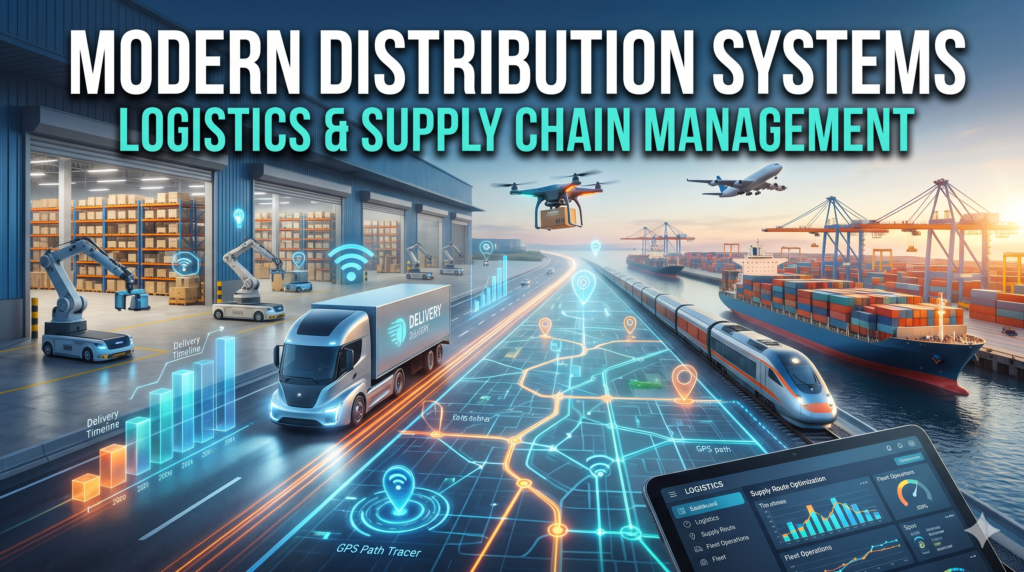
Modern distribution systems decide whether a product reaches the right customer, at the right time, at a cost that still leaves a margin. They sit at the end of the supply chain, inherit every upstream decision, and take the blame when something goes wrong. For anyone running logistics or supply chain management today, understanding how these systems are built is no longer optional.
This guide explains what a distribution system is, how it fits inside logistics and supply chain management, which models and technologies power it, and how to choose and roll out the right setup. You will get a layered model, a technology stack map, a selection framework, a KPI table and a five-phase implementation plan you can adapt whether you run one warehouse or several.
What Is a Distribution System in Supply Chain Management?
A distribution system is the set of facilities, inventory policies, transport links, order processes and software that move finished goods from where they are made or stocked to where customers buy them. It covers five jobs: storing goods, picking and packing orders, moving them between locations, delivering them to the buyer, and handling returns.
In supply chain terms, distribution is the downstream end of the chain. Procurement is judged on cost and lead time, and production on output and quality. Distribution is judged on whether the customer actually received the order, on time and in full. That is why distribution management absorbs so much of the variability that builds up upstream, and why a weak distribution system makes even a well-run factory look unreliable.
Who handles distribution depends on the business. A manufacturer may sell directly to consumers, or sell through wholesalers and retailers. If you are weighing the second route, our guide to distribution channels with intermediaries explains how wholesalers, distributors and retailers share the work and the margin.
How Distribution, Logistics, and Supply Chain Management Fit Together
The three terms are often used as if they mean the same thing. They do overlap, but they sit at different levels, and separating them makes each easier to manage.
| Layer | What it decides | Example metric |
|---|---|---|
| Supply chain management | Strategy across sourcing, production and delivery, including supplier choices and network shape | Total cost to serve, supply chain resilience |
| Distribution management | Where stock sits, which channels are used, how orders flow and what service level is promised | Fill rate, order cycle time |
| Logistics | The physical storing and moving of goods, plus the information flow that supports it | Transport cost per shipment, pick accuracy |
Supply chain management sets the direction. Distribution management makes the stock placement and channel decisions. Logistics carries those decisions out day to day. Many people use logistics and supply chain management interchangeably because their daily work overlaps, but the layered view helps you assign ownership. When an order is late, you can ask whether the cause was a strategy choice (the wrong warehouse location), a distribution choice (the wrong stock policy) or an execution failure (a missed carrier pickup).
Core Components of a Modern Distribution System
Every distribution system, from a single-site online seller to a national wholesaler, is made of the same five building blocks. The difference between a basic setup and a modern one is how well these blocks share data.
Network and Facilities
The network is the physical footprint: plants, central distribution centers, regional hubs, cross-dock points and stores. Modern networks increasingly treat stores as nodes that can ship or hold stock, not only as the end of the line. The key design question is how many locations you need and how close they should be to customers, balancing transport cost against inventory cost.
Inventory Positioning
Where you hold stock matters as much as how much you hold. Centralised stock lowers total inventory and safety stock because demand variation pools in one place. Local stock shortens delivery time and protects service levels. Most operators use a mix, with fast sellers close to customers and slow movers held centrally. Good warehouse inventory management practices, such as accurate location control and cycle counting, are the foundation of any positioning strategy.
Transportation and Carriers
Transportation links every node. Decisions here include which modes to use, whether to run your own fleet or use carriers, how to consolidate loads, and how to plan routes. Last-mile delivery, the final leg to the customer, is usually the most expensive and least predictable part, so it deserves its own planning.
Order Management and Returns
Order management captures orders from every channel, checks stock, allocates inventory to a location and triggers fulfillment. Returns are part of the same flow. A system that handles outbound orders well but treats returns as an afterthought leaks margin and frustrates customers.
Information Flow and Data Synchronisation
Information is what turns separate facilities into a system. Stock levels, order status, shipment events and forecasts all need to move between locations and software without delay or manual re-entry. Safety stock rules and reorder points only work when the underlying numbers are current, which is why the inventory control methods, formulas and KPIs used by your team need to run on live data, not weekly exports.
Types of Distribution Systems and Channels
Distribution systems are usually described along two axes: who reaches the customer, and how goods flow through facilities.
Direct, Indirect and Hybrid Distribution
In direct distribution, the manufacturer or brand supplies the points of consumption itself, for example through its own online store or shops. It offers control over price, brand experience and customer data, but it demands investment in logistics, customer service and marketing. In indirect distribution, the brand sells through wholesalers, retailers, franchises or resellers. It extends reach quickly and shifts some cost to partners, but reduces control and margin. A hybrid model combines both, which is common among omnichannel sellers that run their own store alongside marketplaces and retail partners.
Common Distribution Strategies
Beyond channel choice, companies choose how goods flow through facilities:
- Traditional warehousing: distribution centers hold stock and supply downstream customers as orders arrive.
- Cross-docking: goods move from inbound vehicles to outbound vehicles with little or no storage time. It cuts holding cost and handling but needs reliable inbound timing and shared data.
- Direct shipping: suppliers ship straight to the customer or store, avoiding a distribution center but giving up the risk-pooling benefit of central stock.
- Hub and spoke: shipments are consolidated at a central hub and then sent to regional spokes, which suits dense networks.
- Direct store delivery: suppliers or the company fleet deliver to retail outlets, bypassing the retailer’s central warehouse.
Push, Pull and Push-Pull
In a push model, stock is built or positioned ahead of demand based on forecasts. In a pull model, replenishment is triggered by actual orders. Most real systems are push-pull: bulk stock is pushed to regional locations, and the final allocation is pulled by demand. Promotions complicate this, because a forecast spike can overload stores. For more on that risk, see our guide to retail promotions and inventory management.
| Model | Best for | Main risk | System need |
|---|---|---|---|
| Direct to customer | Brands wanting control and data | High fulfillment and service cost | Strong order management and carrier tools |
| Indirect through partners | Fast reach with lower investment | Lower margin and less control | Partner data sharing and EDI-style integration |
| Hybrid | Omnichannel sellers | Inventory split across channels | Unified inventory view |
| Cross-docking | High-volume, predictable flows | Missed timing creates delays | Real-time inbound visibility |
| Hub and spoke | Dense regional networks | Hub becomes a bottleneck | Route and load planning |
The Technology Stack Behind Modern Distribution
Distribution runs on layered software. Each layer answers a different question, and problems usually appear where layers fail to share data.
| System | What it decides | Key data |
|---|---|---|
| ERP | System of record for orders, finance, purchasing and master data | Items, customers, prices, ledger |
| WMS | What happens inside the warehouse: receiving, putaway, picking, packing | Locations, stock, tasks |
| TMS | Carrier selection, routing, load planning, freight cost | Shipments, rates, routes |
| OMS | Order capture, allocation across locations, returns | Orders, availability, promises |
| DRP | Replenishment from central to regional locations | Demand, lead times, safety stock |
| Visibility layer | Shipment and inventory status across all of the above | Events, ETAs, exceptions |
An enterprise resource planning system acts as the backbone, so it is worth understanding what it does and does not cover before you add anything else. Our overview of enterprise resource planning explains the modules and how they connect to operations.
Inside the four walls, a warehouse management system controls how stock moves. If you are deciding between options, our guides to WMS systems and warehouse software compare types, features and costs. A WMS does things an ERP usually does not, such as directed picking, slotting and wave planning, which is the main reason growing distributors add one.
People and equipment sit under this stack too. A labor management system measures and plans warehouse workforce productivity, and equipment maintenance software keeps conveyors, forklifts and sortation equipment available. Downtime in either one shows up as late orders, so they belong in the distribution conversation even though they are rarely listed in one.
A buying note: start by fixing the layer that causes the most exceptions today, not the layer with the most impressive demo. A distributor with accurate stock but poor carrier visibility needs a TMS or visibility layer before it needs a new WMS.
Automation, AI, and Real-Time Visibility
Automation in distribution is less about robots and more about removing manual decisions that happen thousands of times a day. Common examples include automatic order allocation to the nearest location with stock, alerts when a shipment is likely to miss its delivery window, dynamic slotting in the warehouse and automated reorder suggestions.
Our guide to automated logistics systems covers the main types, their benefits and a practical setup path. Communication channels are part of this too. Drivers, customers and dispatchers often prefer messaging over portals, which is why integrating with tools such as WhatsApp for logistics management can speed up proof of delivery and exception handling. For hands-busy environments like pick floors and loading docks, voice API integration is another option worth evaluating.
AI adds forecasting, route optimisation and exception prediction on top of this. Many ERP vendors now embed these features, and our piece on AI-driven ERP systems explains what that looks like in practice. Be realistic about limits. AI recommendations are only as good as the data feeding them, so duplicate item records, inconsistent units and late status updates will produce confident but wrong outputs.
Pros of automation: fewer manual errors, faster exception response, more consistent service levels, and better use of staff time.
Cons and cautions: integration effort, dependence on clean master data, and the need for human review where decisions carry real cost.
How to Choose the Right Distribution Model
There is no universally best distribution model. Use five factors to narrow the choice, and score each model honestly.
| Factor | Question to ask | Points toward |
|---|---|---|
| Product type | Is it perishable, bulky, high value or fast moving? | Perishable or fast movers favor shorter, faster flows such as cross-docking or local stock |
| Order volume | Are orders large and predictable, or small and scattered? | Large and predictable favors cross-docking or direct shipping; small and scattered favors central stock |
| Speed promise | What delivery time have you promised customers? | Tight promises favor regional or local inventory |
| Margin | How much cost can each order absorb after fulfillment? | Thin margin favors consolidation and indirect channels |
| Control | How important are brand experience and customer data? | High importance favors direct or hybrid models |
Consider a mid-size consumer goods seller with an online store and a few retail partners. If most orders are small and customers expect fast delivery, central stock alone will struggle. A reasonable answer is a hybrid: hold fast sellers in a regional location, keep slow movers centrally, and ship bulk retail orders through a consolidated indirect route.
Cost to serve should sit behind every choice. It combines the landed cost of sourcing a product with the cost of delivering it to a given customer or channel. How you value inventory also affects reported margin, so it helps to understand how the selected inventory costing method impacts your numbers before comparing channel profitability.
On the build-or-outsource question, a third-party logistics provider suits businesses with uneven volume, little warehouse experience or a need to enter new regions quickly. Owning facilities suits stable volume, special handling needs or a strong desire for control.
Key Metrics for Distribution and Logistics Performance
Track a small set of metrics consistently, with one definition per metric that everyone agrees on.
| Metric | Formula | What a bad number signals | First fix |
|---|---|---|---|
| Fill rate | Units shipped divided by units ordered | Stockouts or poor allocation | Review safety stock and reorder points |
| On-time in-full (OTIF) | Orders delivered on time and complete divided by total orders | Carrier, picking or stock issues | Break failures down by cause |
| Order cycle time | Time from order placed to order delivered | Slow processing or transit | Map the order flow and find the longest wait |
| Inventory turnover | Cost of goods sold divided by average inventory | Overstock or slow movers | Reduce stock on slow items |
| Cost to serve per order | Total fulfillment and delivery cost divided by orders | Low-margin channels or routes | Compare by channel and customer group |
| Perfect order rate | Orders with no error in any step divided by total orders | Errors in picking, documents, delivery or billing | Audit the most common error type |
Pick two or three that match your biggest pain point first. A distributor with frequent stockouts starts with fill rate and turnover. A retailer with delivery complaints starts with OTIF and order cycle time. For deeper formulas and setup advice on the inventory side, the methods covered in our inventory control guide pair well with this table.
Common Challenges and How to Fix Them
Last-mile cost pressure. Delivery to the customer is typically the costliest leg. Reduce it with route planning, delivery windows, consolidation, pickup options and, where it makes sense, using stores as fulfillment points.
Data silos between systems. When the WMS, TMS and ERP each hold a different version of the truth, teams work from conflicting numbers. Fix this by defining one system of record per data type and monitoring the flows between them. Practices such as business process monitoring help you see where a process stalls or data fails to sync before customers notice.
Demand spikes. Promotions, seasons and viral orders strain stock and capacity. Plan promotions together with inventory and carrier capacity, and use pull-based replenishment where you can.
Supplier and trade disruption. Tariffs, port delays and supplier failures break assumptions. Qualify alternative suppliers, review your network design regularly and keep safety stock for critical items.
System outages. Distribution now depends on cloud services, so an outage can stop picking, labeling and dispatch at once. Our analysis of an AWS outage and how to protect your business outlines practical safeguards such as fallback procedures and vendor dependency reviews.
A Five-Phase Implementation Roadmap
Rolling out or modernising a distribution system works best in phases, with a clear owner and deliverable for each.
- Map the current flow. Owner: operations lead. Deliverable: a documented order-to-delivery map with the top five pain points and baseline metrics.
- Fix data and master records. Owner: data or ERP administrator. Deliverable: clean item, location and customer records with agreed units and naming.
- Connect core systems. Owner: IT or integration partner. Deliverable: working data flows between ERP, WMS, TMS and order channels. Our guide to CRM and ERP integration is a useful reference for connecting customer and operations data.
- Automate exceptions. Owner: process owner. Deliverable: rules and alerts for the most common failures, starting with late shipments and stockouts. The ideas in small business automation apply directly here, and our custom CRM automation services can handle the build if you lack in-house capacity.
- Measure and iterate. Owner: operations lead with finance. Deliverable: a monthly review of the KPI table above, with one improvement chosen each cycle.
Timelines depend on the number of systems, the quality of your data and how much integration is needed. A realistic plan is built from your own baseline, not from a generic number.
Frequently Asked Questions
What is a distribution system in supply chain management?
A distribution system is the combination of facilities, inventory policies, transport, order processing and software that moves finished goods from the point of production or storage to customers. It sits at the downstream end of the supply chain and is judged on whether orders arrive on time and in full.
Is distribution part of logistics or supply chain management?
Both. Distribution management is part of supply chain management and decides where stock sits and which channels to use. Logistics carries out the physical storing and moving of goods. The terms overlap in daily use, but they operate at different levels.
What are the main types of distribution systems?
The main channel types are direct, indirect and hybrid distribution. Within them, common flow strategies include traditional warehousing, cross-docking, direct shipping, hub and spoke, and direct store delivery. Many companies combine several.
What does a WMS do that an ERP does not?
An ERP records orders, inventory and finances across the business. A WMS manages what happens inside the warehouse, including receiving, putaway, directed picking, packing and slotting. Growing operations usually add a WMS when ERP-level inventory control is no longer detailed enough.
Which KPIs should a small distributor track first?
Start with fill rate, on-time in-full and inventory turnover. They show whether you have the right stock, whether customers receive complete orders on time and whether capital is tied up in slow items. Add cost to serve once you can measure it by channel.
How long does a distribution system rollout take?
It depends on how many systems you connect, how clean your data is and how many locations you run. Build the timeline from a baseline of your own processes, and phase the work so each stage delivers a measurable improvement before the next begins.
Conclusion
Modern distribution systems are more than warehouses and trucks. They are a layered combination of network design, inventory placement, transport, order management and connected software, all working inside the wider logistics and supply chain management framework. The operators who perform best pick a model that fits their products and customers, connect their systems so data flows without delay, and measure a small set of KPIs consistently.
Your first action can be simple: map one order from placement to delivery and note every point where it waits or a person re-enters data. That map shows where a better model, tool or automation will pay off fastest. If you want help turning it into a plan, talk to our team or explore our technical consultation service.