
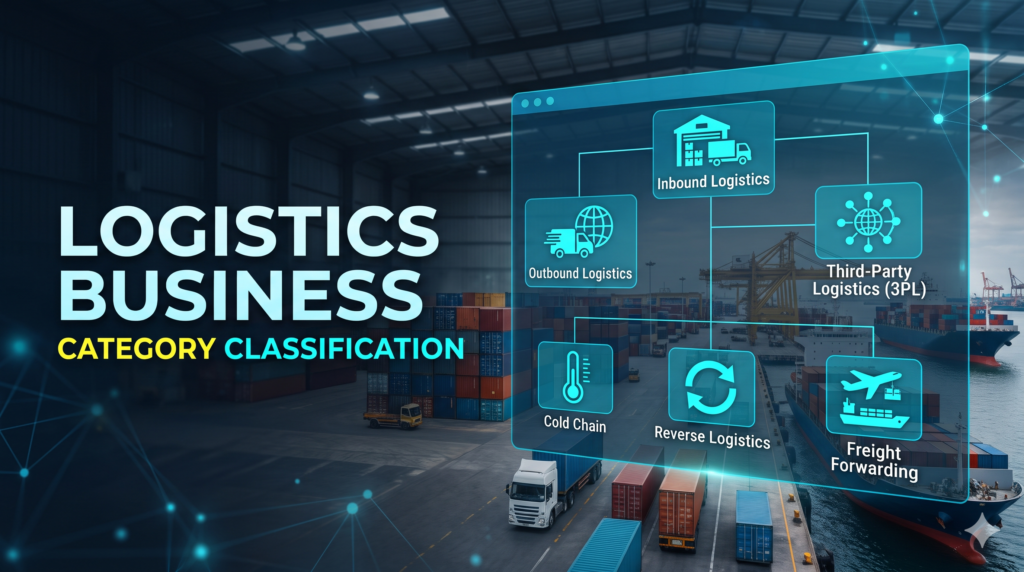
Why Logistics Business Category Classification Matters
Ask three people what kind of logistics business a company is and you may get three answers. One calls it a freight forwarder, another a third-party logistics provider, and a government form files it under transportation support. All three can be right, because logistics business category classification has no single official system. The same company can be described through several lenses at once.
This guide explains the four lenses that matter in practice: the service model (1PL to 5PL), the business function, asset ownership, and the industry code. By the end you will know which categories exist, how they differ, and how to classify your own company with a clear method.
Short answer: classify a logistics business by what it sells and earns from. Pick a service model, name the main functions, note whether it owns assets, and then choose one primary industry code that matches its largest revenue source.
What Logistics Business Category Classification Means
Classification is the practice of placing a company in a defined group so that others can compare it, insure it, tax it, regulate it or buy from it. Three related ideas are often mixed up, so it helps to separate them:
- Service model describes how much of a client’s logistics the provider takes over, from none to the whole network.
- Business function describes the actual activity, such as trucking, storage, forwarding or last-mile delivery.
- Industry code is the official label a statistics agency assigns, such as a NAICS code in North America.
The industry code layer is the least tidy. The WTO notes that its services classification contains no separate category for logistics, and the ITC makes the same point in its logistics brief. Trade partners therefore treat logistics as a checklist of related sectors rather than one group. That is why a logistics company is spread across transportation, warehousing and support activity codes.
Logistics providers also sit between shippers and carriers. If you want to see how such go-betweens work from the sales side, our guide to intermediaries in the distribution channel covers the same idea.
Classification by Service Model: 1PL to 5PL
The service model view is the most common way to describe types of logistics companies. It ranks providers by how much of the logistics work a client hands over. Sources agree on the first four levels and disagree on the fifth.
1PL: First-Party Logistics
A 1PL is a business that handles its own logistics with its own vehicles, warehouses and staff. The shipper and the customer are the only two parties. Small producers with local delivery often work this way.
2PL: Second-Party Logistics
A 2PL is an asset-based carrier that moves goods but does little else. Trucking companies, airlines and ocean lines belong here. The client still plans, stores and manages everything around the movement.
3PL: Third-Party Logistics
A 3PL takes over several logistics functions for a client, typically warehousing and transportation, and often inventory handling, packing and tracking. Contract logistics is the term many companies use for this arrangement. Most medium-sized shippers who outsource logistics use a 3PL.
4PL: Fourth-Party Logistics
A 4PL manages the logistics network on the client’s behalf. It coordinates several 3PLs and carriers, usually using its own technology, and often does not own the physical assets. The difference between 3PL and 4PL is that the 3PL does the work while the 4PL orchestrates who does it.
5PL: Fifth-Party Logistics
The 5PL label is the least settled. Some publishers describe a 5PL as a technology-led architect that builds a connected, data-driven network across the whole supply chain. Others describe it as an aggregator that combines the volume of several 3PLs to negotiate better carrier rates. This article uses the technology-led meaning because it matches how the label is used for platform-based providers, but you should check which definition a vendor means before you rely on the term.
| Level | Who does the work | Typically owns assets | Typical example |
|---|---|---|---|
| 1PL | The shipper itself | Yes | A manufacturer with its own fleet |
| 2PL | Carrier hired for movement | Yes | A trucking company or shipping line |
| 3PL | Provider for several functions | Often | A warehouse and distribution operator |
| 4PL | Coordinator of several providers | Rarely | A supply chain manager that runs a carrier network |
| 5PL | Technology-led network layer | Rarely | A platform that connects and optimizes many providers |
Most shippers do not sit in one level. An importer may use a 2PL carrier, a 3PL warehouse and a 4PL coordinator at the same time.
The practical lesson is that the party level describes a relationship, not a permanent label. The same logistics company can act as a 2PL for one client who only wants trucking and as a 3PL for another who also wants storage and fulfillment. When you describe your business, name the level you operate at for most clients and mention the others as secondary services.
Classification by Business Function
The function view answers a simpler question: what does the company actually do? Each group below is a different kind of logistics business, and many companies combine several.
Freight Transportation
These companies move cargo by road, rail, air or sea. Trucking is split further into local and long-distance work, and into truckload and less-than-truckload service. Specialized freight, such as oversized or hazardous loads, is treated separately.
Freight Arrangement
Freight forwarders, freight brokers, customs brokers and shipping agents do not necessarily move goods themselves. They arrange transportation between shippers and carriers and handle paperwork. Many are non-asset-based businesses.
The line between forwarder and broker is worth stating clearly. A freight forwarder usually arranges the full movement, often across borders, and handles documentation. A freight broker matches a shipper with a carrier, typically for domestic road freight. Both are arrangement businesses, which is why they share one NAICS code.
Warehousing and Storage
Warehousing firms store, handle and distribute goods. General warehouses differ from refrigerated warehouses that hold temperature-controlled products. Running these sites well depends on accurate stock records, which is why warehouse inventory management is central to this category.
Courier, Express and Last-Mile Delivery
Courier and express companies deliver parcels and documents on tight schedules. Last-mile delivery is the final leg to the customer and is the most visible and costly part of many e-commerce operations.
Reverse Logistics
Reverse logistics handles returns, repairs, recycling and disposal. It reverses the usual flow from customer back to seller or manufacturer and is a growing specialty in retail. Providers in this group need systems that can grade returned items, route them to resale, repair or disposal, and report the result back to the client.
Packing, Crating and Logistics Consulting
Some businesses sell packing and crating services. Others sell advice on physical distribution, inventory planning and logistics management without moving any goods.
Asset-Based vs Non-Asset-Based Logistics Businesses
Asset ownership is the third lens. An asset-based business owns trucks, aircraft, vessels, warehouses or equipment. A non-asset-based, or asset-light, business owns few or none and sells coordination, capacity and expertise.
| Factor | Asset-based | Non-asset-based |
|---|---|---|
| Examples | Carriers, warehouse operators | Brokers, forwarders, 4PL managers |
| Capital need | High | Lower |
| Control over service | High | Depends on partners |
| Main risk | Idle capacity and fixed costs | Reliance on third-party carriers |
| Scaling | Slower, tied to assets | Faster, tied to relationships and systems |
Many companies are hybrids. A carrier may broker overflow loads, and a forwarder may lease warehouse space. When you classify a hybrid, note which side generates most of the revenue.
Logistics Classification by Industry Codes: NAICS and ISIC
Industry codes are what regulators, insurers and statistics agencies use. In North America the system is NAICS. Internationally, ISIC is the parallel, and many countries publish a national version. The Philippine PSIC, for example, groups logistics planning, forwarding and customs agent activity under group 522, support activities for transportation.
The table below maps common logistics functions to NAICS codes. Confirm every code in the current Census NAICS search before you use it on a filing, because titles and structures are revised.
| Function | NAICS code | Title |
|---|---|---|
| Local general freight trucking | 484110 | General Freight Trucking, Local |
| Long-distance truckload | 484121 | General Freight Trucking, Long-Distance, Truckload |
| Long-distance less-than-truckload | 484122 | General Freight Trucking, Long-Distance, Less Than Truckload |
| Local specialized freight | 484220 | Specialized Freight (except Used Goods) Trucking, Local |
| Long-distance specialized freight | 484230 | Specialized Freight (except Used Goods) Trucking, Long-Distance |
| Forwarding, brokerage, customs brokers | 488510 | Freight Transportation Arrangement |
| General warehousing | 493110 | General Warehousing and Storage |
| Refrigerated warehousing | 493120 | Refrigerated Warehousing and Storage |
| Courier and express | 492110 | Couriers and Express Delivery Services |
| Packing and crating | 488991 | Packing and Crating |
| Other road transport support | 488490 | Other Support Activities for Road Transportation |
| Logistics consulting | 541614 | Process, Physical Distribution, and Logistics Consulting Services |
Notice that there is no code called simply “logistics.” A company that does several things is classified by its primary activity, usually the one that produces the largest share of revenue.
The consulting code is a useful reminder that advice and operations are classified differently. A firm that designs a client’s distribution network but never touches the freight belongs with consultants, while a firm that runs the network belongs with the operating categories. If your business does both, keep the revenue split clear so the primary code is easy to defend.
Classification by Mode, Cargo and Geography
Three secondary lenses refine the picture.
- Mode: road, rail, air, sea or multimodal.
- Cargo: general freight, refrigerated cold chain goods, hazardous materials, or oversized and project cargo.
- Reach: local delivery, regional distribution or cross-border and international forwarding.
These labels rarely replace the main classification, but they help buyers compare providers. A cold chain 3PL and a general merchandise 3PL share a service model yet need very different equipment and compliance work. The same applies to reach. A local courier and a cross-border forwarder may both be called logistics companies, but customs rules, documentation and insurance differ sharply between them.
How to Classify Your Own Logistics Business, Step by Step
- List every revenue source. Write down each service you invoice for, such as trucking, storage, forwarding fees and packing.
- Find the largest source. The activity that earns the most revenue usually decides the primary industry code.
- Check asset ownership. Note whether you own vehicles and facilities or coordinate partners.
- Choose the service model. Decide whether you act as a 2PL carrier, a 3PL provider, a 4PL coordinator or a mix.
- Map to a code. Match the primary activity to a NAICS code from the Census search and record the ISIC equivalent if you work internationally.
- Confirm with your adviser. Ask your insurer and tax adviser to confirm the category they apply to your business.
Worked example. A regional company trucks local freight, runs one general warehouse and arranges occasional forwarding for customers. Trucking brings in 55 percent of revenue, storage 30 percent and forwarding 15 percent. Its primary code is a local general freight trucking code, its service model is a 2PL that also operates as a 3PL for warehousing clients, and it is asset-based. The storage and forwarding work is recorded as secondary functions, not as the main code.
Warehousing businesses should also keep their stock records and accounting aligned. Reliable inventory control methods and the right inventory costing method make that easier.
Why the Right Category Matters for Insurance, Compliance and Tax
A category is more than a label. It affects real costs and obligations.
- Insurance: classification of logistics employers for insurance depends on which fee-based services the company performs. California’s workers compensation rating bureau, for example, notes that many logistics firms only handle or forward customers’ goods in transit, while others also store or truck goods, and the correct class depends on that mix.
- Licensing and compliance: carriers, brokers and customs brokers each face different licensing and registration rules, so mislabeling a business can create gaps.
- Tax and reporting: industry codes feed statistical reporting and can influence how filings are processed.
- Procurement: government and enterprise buyers often screen suppliers by code.
- Contracts and partnerships: shippers compare providers inside the same category, so a clear classification helps your company appear in the right shortlist.
This section is general information, not legal or insurance advice. Confirm the right category with a licensed adviser rather than self-classifying for insurance.
Which Software Fits Each Logistics Category
Each category has a different operational bottleneck, so each needs different systems.
| Category | Core need | Software type |
|---|---|---|
| Warehousing and 3PL | Stock accuracy, picking, putaway | Warehouse management system |
| Labor-heavy operations | Productivity and scheduling | Labor management |
| Carriers and equipment owners | Uptime and servicing | Maintenance management |
| Forwarders, brokers, 4PL | Quotes, shipments, customer records | ERP with CRM |
| Small operators | Repetitive manual tasks | Workflow automation |
Warehouse operators should start with WMS systems and compare options in our guide to warehouse software. Operations with large teams can add a labor management system to track productivity. Companies that run many functions often centralize them in enterprise resource planning.
Fleet and equipment owners need to keep assets running. A computerized maintenance management system or dedicated equipment maintenance software schedules servicing and reduces breakdowns. Forwarders and brokers benefit from CRM and ERP integration so that customer records and shipment data stay in sync.
Common Classification Mistakes
- Treating a forwarder as a carrier. Forwarders arrange transport and usually do not move the goods.
- Using one code for a mixed business. Choose the primary revenue activity and record the rest as secondary.
- Copying a competitor’s code. Their revenue mix may differ from yours.
- Ignoring asset status. Owning or not owning assets changes risk, insurance and the way buyers see you.
- Never revisiting the category. A company that adds warehousing or forwarding may outgrow its original classification.
- Mixing up the service model with the industry code. Calling yourself a 3PL describes how you serve clients. It does not replace the code on your registration.
- Using marketing language as classification. Terms such as end-to-end or full-service describe positioning, not category.
Frequently Asked Questions
What are the main categories of logistics businesses?
Logistics businesses are usually grouped by service model (1PL to 5PL), by function (freight transport, freight arrangement, warehousing, courier and last-mile delivery, reverse logistics, consulting), by asset ownership (asset-based or non-asset-based) and by industry code such as NAICS. Most companies fit more than one lens at the same time.
What is the difference between 3PL and 4PL?
A 3PL performs physical logistics work such as warehousing and transportation for a client. A 4PL sits above that layer and coordinates several 3PLs and carriers, usually without owning the trucks or warehouses itself.
Which NAICS code applies to a freight forwarder?
Freight forwarders, customs brokers and shipping agents are generally classified under NAICS 488510, Freight Transportation Arrangement. Confirm the current code in the Census NAICS search before using it on a filing.
Is a trucking company a logistics business?
Yes, in the broad sense. A trucking company is a transportation provider and sits in the 2PL group in the service model view. It becomes a 3PL only when it also takes on services such as warehousing, inventory handling or distribution management.
Can a company belong to more than one logistics category?
Yes. A company can truck freight, run a warehouse and arrange forwarding at the same time. It still needs one primary industry code based on its largest source of revenue, while its service model and function labels can reflect the full mix.
What software suits a small logistics business?
It depends on the category. Warehousing firms usually start with a warehouse management system, fleet owners need maintenance software, and forwarders or brokers need ERP and CRM tools that work together. Small operators can also begin by automating repetitive tasks before buying large platforms.
For small teams, our guide to small business automation is a practical place to begin.
Conclusion and Next Steps
Logistics business category classification works best when you use all four lenses together: service model, function, asset ownership and industry code. Choose one primary code based on revenue, describe the rest as secondary functions, and revisit the choice as the business grows.
If you want help connecting the systems behind each category, explore our custom CRM and automation services or our digital consulting and process automation work, or book a call to talk through your setup.