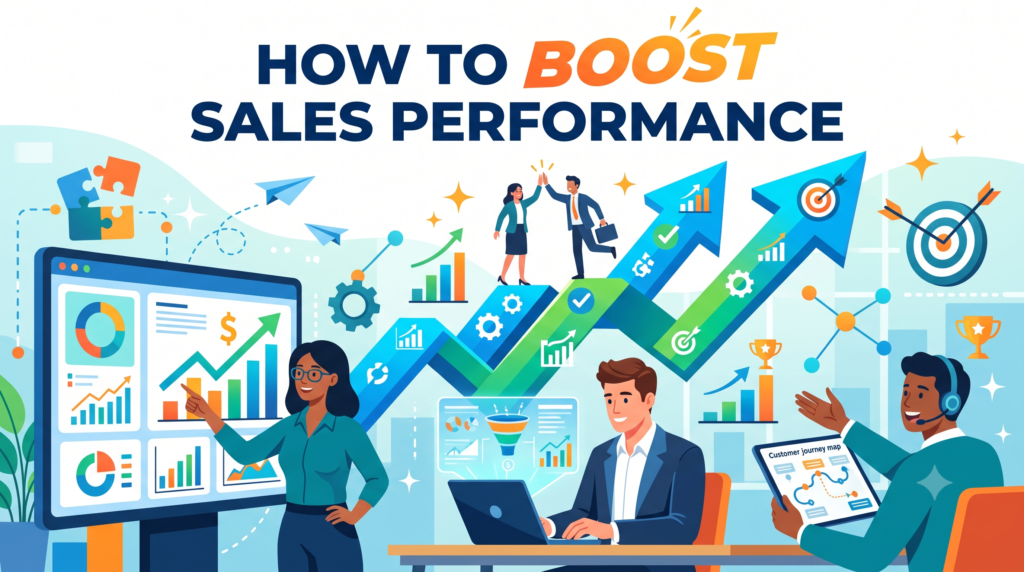
Every business owner wants to know how to boost sales performance, yet most teams chase the wrong levers. They buy more leads, push the sales team harder, or discount prices, and the results stay flat. Real sales performance improvement comes from a connected system: a clear sales process, a healthy sales pipeline, the right tools, consistent coaching, and honest measurement. When these parts work together, you increase sales without burning out your people or your margins.
This guide walks through ten practical strategies you can apply this quarter. Each one is written for small and mid-sized service businesses, agencies, and growing companies that want predictable revenue rather than occasional wins. You will also find a 90-day action plan, a list of common mistakes, and answers to the questions owners ask most often about sales performance.
What Sales Performance Really Means
Sales performance is the measurable ability of your business and your sales team to turn prospects into paying customers at a healthy margin. It is not only about total revenue. A strong sales performance picture includes how many qualified leads enter your pipeline, how many convert, how long deals take to close, how large each deal is, and how many customers stay and buy again.
Thinking about sales performance as a chain helps. Marketing attracts attention, the website builds trust, the sales team qualifies and persuades, operations delivers, and customer success drives repeat revenue. A weak link anywhere reduces the whole result. That is why the best way to boost sales performance is rarely a single trick. It is a series of small, compounding improvements across the entire customer journey.
Why Sales Performance Stalls
Before you improve anything, understand why growth slows. Most stalled sales teams share a handful of problems.
First, the sales process lives in people’s heads. Each rep sells differently, so results vary wildly and nothing can be coached or repeated. Second, lead quality is poor. Reps spend their best hours on prospects who were never a fit. Third, follow-up is inconsistent. Many deals are lost simply because nobody replied quickly or persistently enough. Fourth, data is scattered across spreadsheets, inboxes, and memory, so managers cannot see where deals are stuck. Finally, targets are set without a clear link to activity, so teams know the goal but not the daily behavior that reaches it.
Each of these problems has a practical fix, and the ten strategies below address them in order.
Strategy 1: Build a Clear, Repeatable Sales Process
The foundation of any plan to boost sales performance is a documented sales process. A sales process is the set of stages every opportunity passes through, from first contact to signed deal, along with the actions and exit criteria for each stage.
Start simple. Most service businesses can work with five or six stages, such as new lead, qualified, discovery call, proposal sent, negotiation, and closed. For each stage, write down what must be true before a deal moves forward. For example, a lead is only qualified when you have confirmed budget range, decision maker, timeline, and a real problem you can solve.
A written process delivers three benefits. New reps ramp up faster because they follow a proven path. Managers can forecast revenue more accurately because stages mean the same thing to everyone. And you can find the exact stage where deals die, which tells you where to focus improvement. If your process also needs smarter workflows behind the scenes, the team at The Cloud Republic offers digital consulting and process automation that helps turn a loose routine into a system.
Strategy 2: Define Your Ideal Customer and Qualify Ruthlessly
No sales strategy can rescue a pipeline full of poor-fit prospects. To increase sales efficiently, define your ideal customer profile in concrete terms: industry, company size, budget, the problem they feel most, and the triggers that make them ready to buy.
Then build a short qualification checklist and apply it before a lead takes up serious sales time. Ask whether the prospect has a real, urgent problem, whether they have authority and budget, and whether your solution is genuinely a good match. Saying no early protects your team’s time and raises your conversion rate because reps focus on opportunities that can actually close.
Qualification also works upstream. When your marketing speaks clearly to one type of customer, the leads that arrive are already closer to a fit. If you want to attract better prospects automatically, explore how AI-powered lead generation and prospecting software can surface and score the right leads before a rep ever picks up the phone.
Strategy 3: Make Your Website Work as a Sales Asset
Your website is often the first salesperson a prospect meets, and it works around the clock. If it loads slowly, hides your offer, or gives visitors no clear next step, you lose sales before a conversation even starts. Many owners see steady traffic but few inquiries, which is a conversion problem, not a traffic problem.
Focus on the basics that influence buying decisions. State what you do and who you serve in the first screen. Show proof such as case studies, reviews, and recognizable results. Place one clear call to action on every key page. Keep forms short. And make sure the site is fast on mobile, because impatient visitors leave quickly.
If this sounds familiar, read the guide on what to do when your website gets traffic but no inquiries for a diagnostic approach. Speed deserves its own attention, and this article on why website speed is costing you clients explains how delays quietly damage conversion. When a site needs deeper work, professional web design and development aligned with your sales goals gives your team a far stronger starting point.
Strategy 4: Use a CRM to Run Your Sales Pipeline
A customer relationship management system is the single most useful tool for sales performance improvement. A CRM stores every contact, conversation, task, and deal in one place so nothing slips through the cracks. It also gives you a live view of your sales pipeline, which makes forecasting and coaching far more accurate.
To get real value, use the CRM consistently. Every lead should be logged, every deal should sit in a stage, and every next step should have a due date. Build dashboards for pipeline value by stage, average deal size, win rate, and time in stage. Review them in your weekly sales meeting rather than letting them gather dust.
Choosing the right platform matters. Our comparison of the best CRMs for service-based small businesses helps you match features to your budget and workflow, and the overview on the power of CRM systems explains how a CRM lifts every part of the sales cycle. If your needs go beyond off-the-shelf software, custom CRM automation services can tailor workflows to the way your team actually sells. Connecting your CRM to the tools your reps already use also helps adoption, for example through CRM with Gmail integration so emails log automatically.
Strategy 5: Master Lead Nurturing and Follow-Up Automation
Most buyers are not ready on the first contact. Lead nurturing keeps your business visible and helpful until they are. The aim is simple: deliver the right message at the right time, so the prospect remembers you when the need becomes urgent.
Build nurture sequences for each stage. A new inquiry might receive a quick acknowledgment, a helpful resource, and a prompt to book a call. A prospect who attended a demo but went silent might receive a case study, a short FAQ, and a gentle check-in. Speed matters most at the start, since fast responses consistently signal professionalism and keep interest high.
Automation makes this consistent without adding workload. Read how to automate client onboarding, follow-ups, and booking for practical examples, and see how marketing automation platforms can trigger messages based on behavior. Email remains one of the most dependable nurture channels, and you can connect it directly by learning how to integrate your CRM with email marketing. For businesses that want expert help, a dedicated marketing automation agency can design and manage the whole system.
Strategy 6: Invest in Sales Coaching and Skill Development
Training happens once. Sales coaching happens continuously, and it is where sustained improvement comes from. Great managers observe real calls, give specific feedback, and help reps practice the exact moments that cost deals, such as handling price objections or asking for the next step.
A practical coaching rhythm looks like this. Review two or three recorded or live calls per rep each week. Pick one skill to improve at a time, such as discovery questions or closing language. Role-play difficult scenarios in short team sessions. Celebrate and share what top performers do so the whole team learns from it.
Good coaching also depends on clear role design. If you are building or restructuring a team, the article on what a marketing manager does is useful for understanding how marketing and sales roles should connect. Pair coaching with call data when possible. Tools such as call tracking software for lead generation show which campaigns produce calls and give managers real conversations to review and improve.
Strategy 7: Track the Right Sales KPIs
You cannot boost sales performance if you do not measure it. The goal is a small set of sales KPIs that connect activity to outcomes, not a wall of vanity numbers.
A strong starting set includes the following. Lead volume and lead quality show whether the top of the funnel is healthy. Conversion rate at each pipeline stage reveals where deals leak. Average deal size and sales cycle length show efficiency. Win rate shows how well you compete. Customer acquisition cost and customer lifetime value show whether growth is profitable. Finally, pipeline coverage, meaning pipeline value divided by target, tells you early whether you are on track.
Review these numbers weekly and act on them. If lead volume is fine but proposal-to-close is low, the fix is in your offer or negotiation, not in more marketing. If the sales cycle is long, look for stalled stages and add follow-up triggers. Measuring regularly turns opinions into evidence and gives your team a fair, shared definition of progress.
Strategy 8: Align Marketing and Sales Around One Revenue Goal
Sales performance suffers when marketing and sales operate as separate teams with separate goals. Marketing celebrates leads, sales complains about lead quality, and nobody owns the gap. Alignment closes it.
Agree on the definition of a qualified lead and a service level for follow-up. Share one dashboard so both teams see the same funnel. Hold a short monthly meeting where sales shares what customers are asking and objecting to, and marketing turns those insights into content, ads, and landing pages. This feedback loop is a powerful way to increase sales because your messaging gets sharper with every cycle.
Content and search are central to alignment. A solid SEO content strategy answers the questions buyers ask before they talk to sales, which shortens the cycle and improves lead quality. If you are new to the topic, start with this guide on what SEO services include, and for location-based companies, the local SEO checklist for service businesses in Orange County shows how to capture nearby buyers who are ready to act. For paid channels, the overview of internet advertising platforms helps you choose where to invest. To see how all of these pieces fit together, read about building a digital ecosystem where your website, CRM, and SEO work together.
Strategy 9: Sharpen Discovery, Proposals, and Objection Handling
The moments between first call and signed contract decide most outcomes. Three habits raise close rates reliably.
The first is deeper discovery. Instead of pitching early, ask questions that uncover the cost of the problem, what has been tried before, who else is involved, and what success looks like. Prospects who feel understood trust your recommendation. The second is a proposal that mirrors the buyer’s own words. Restate their goals, show a clear scope and price, and explain the expected result. Send it quickly and schedule the review call before the meeting ends. The third is calm objection handling. Treat objections as requests for information. When a prospect says the price is too high, explore what they are comparing it to and reconnect the price to the value of solving the problem.
Also reduce friction at the end. Simple agreements, clear onboarding steps, and fast booking links remove reasons to delay. Many businesses improve closing speed simply by making the next step obvious and effortless.
Strategy 10: Retain Customers and Grow Revenue From Existing Clients
The cheapest sale is usually the next one to a satisfied customer. Retention and expansion are often overlooked in sales performance plans, yet they stabilize revenue and lower acquisition costs.
Create a simple customer success rhythm. Check in after delivery, ask for feedback, and schedule regular reviews for ongoing clients. Look for natural upsell and cross-sell moments, such as a customer outgrowing a plan or needing an additional service. Ask happy clients for referrals and testimonials, which feed your marketing and shorten future sales cycles.
A structured onboarding experience supports retention from day one. Learn how client journey automation keeps customers informed and engaged after they sign. If you run an online store, connecting your systems through CRM and ecommerce integration lets you segment buyers and trigger repeat-purchase offers automatically.
A 90-Day Plan to Boost Sales Performance
Strategy only matters when it becomes action. Here is a simple 90-day sequence you can follow.
In the first thirty days, focus on foundations. Document your sales process and stage definitions, write your ideal customer profile and qualification checklist, audit your website for clear calls to action, and choose or clean up your CRM so every active deal is logged correctly.
In days thirty-one to sixty, build momentum. Set up lead nurturing sequences and fast-response automation, choose your core sales KPIs and build a weekly dashboard, start a weekly coaching rhythm with call reviews, and hold your first marketing and sales alignment meeting.
In days sixty-one to ninety, optimize. Review KPI trends and identify the single biggest leak in your pipeline, improve proposals and objection handling based on real deal feedback, launch a retention and referral routine for existing customers, and adjust your content and ad plans using what sales is hearing. If you want a structured roadmap rather than building it alone, the Digital Growth Blueprint and the Business Automation Growth Package are designed for exactly this kind of systematic improvement.
Common Mistakes That Hold Sales Performance Back
A few errors appear again and again. Chasing volume instead of fit fills the pipeline with deals that never close. Skipping follow-up leaves money on the table because most buyers need several touches. Using a CRM inconsistently makes the data useless. Setting targets without activity goals leaves teams guessing. Relying on discounts erodes margin and trains customers to wait for deals. And changing too many things at once makes it impossible to know what worked. Improve one lever at a time, measure the result, and keep what works.
Frequently Asked Questions About Sales Performance
What is the fastest way to boost sales performance?
The fastest gains usually come from improving follow-up speed and consistency, plus fixing the biggest leak in your pipeline. Responding to new leads quickly and following up on stalled proposals often lifts conversion without any new spending.
How do I increase sales without lowering prices?
Focus on value and fit. Qualify better, run deeper discovery, present clear outcomes in proposals, and build trust with proof such as case studies. Buyers who see strong value rarely need a discount to say yes.
Which sales KPIs matter most for a small business?
Start with lead volume, conversion rate by stage, average deal size, sales cycle length, win rate, and customer acquisition cost. These cover the full journey and point directly to what needs attention.
How often should I coach my sales team?
Weekly coaching works well for most teams. Short, focused sessions on one skill at a time are more effective than occasional long training days.
Do I really need a CRM?
If you manage more than a handful of active deals, yes. A CRM prevents lost leads, improves forecasting, and gives you the data you need to coach and improve.
How long does it take to see results?
Some improvements, such as faster follow-up, show results within weeks. Process, coaching, and alignment changes usually compound over two to three months, which is why a 90-day plan is a realistic starting point.
Final Thoughts: Make Sales Performance a System, Not a Hope
Learning how to boost sales performance is really about building a system you can trust. Define your sales process, focus on the right customers, turn your website into a sales asset, run your sales pipeline in a CRM, nurture leads consistently, coach your team, measure the right sales KPIs, align marketing and sales, close with confidence, and keep customers for the long term. Each improvement is modest on its own, and together they create steady, predictable revenue growth.
If you would like expert support turning these ideas into a working system, The Cloud Republic helps businesses connect websites, CRM, automation, and SEO into one growth engine. Explore the full range of services, or book a call to talk through your sales goals with the team.