
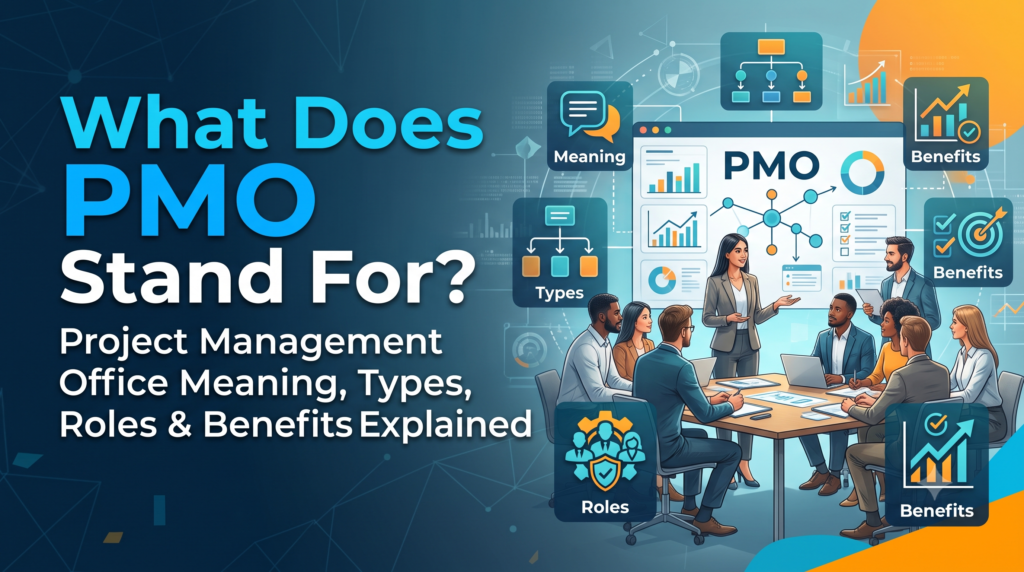
If you have ever seen “PMO” in a job post, a status meeting invite or a company org chart and quietly wondered what it means, you are not alone. The acronym shows up everywhere in modern business, yet many professionals use it without a clear definition. This guide answers the question “what does PMO stand for” in plain language, then goes much deeper into the project management office meaning, the different PMO types, the roles inside a PMO, the benefits, the common problems and the exact steps to build one.
Whether you run a growing company, work in operations, manage projects or are preparing for a career in project management, you will leave this article knowing what a PMO is, what it does and whether your organization needs one. Along the way, we link to related guides from our guide to boosting sales performance and other practical resources so you can connect PMO thinking to everyday business results.
What Does PMO Stand For?
PMO most commonly stands for Project Management Office. A project management office is a group, department or function inside an organization that defines project management standards, supports project teams and keeps projects aligned with business goals. In short, the PMO is the central hub that helps an organization deliver projects in a consistent, visible and well-governed way.
Some companies write the same idea slightly differently, such as Program Management Office or Project Management Organization, but the heart of the definition does not change. A PMO exists to bring order to how work gets planned, approved, tracked and delivered. It does not replace project managers. It gives them templates, rules, tools, training and executive visibility so that their projects have a better chance of finishing on time, on budget and on scope.
A helpful way to remember the meaning of PMO is to think of it as the “control tower” of project work. Airplanes still need pilots, but a control tower keeps every flight coordinated and safe. In the same way, projects still need project managers, but the PMO keeps the whole portfolio coordinated.
Other Meanings of PMO You May Come Across
Although Project Management Office is the dominant meaning in business, the same three letters can point to other things depending on context. Knowing the alternatives prevents confusion when you read a document or a job description.
Program Management Office
In larger organizations, the PMO may oversee a group of related projects known as a program. In that case, the P stands for Program. The focus shifts from single project delivery to coordinating dependencies, shared resources and combined benefits across several projects at once.
Portfolio Management Office
A Portfolio Management Office, often written as PfMO, sits even higher. It prioritizes which projects and programs the organization should fund, balance and stop, based on strategy and available capacity. Many PMOs start with the project focus and grow into program and portfolio roles as the organization matures.
Prime Minister’s Office
In government and politics, PMO often refers to the Prime Minister’s Office, the executive office that supports a prime minister. This meaning has nothing to do with project governance, so always check the context before assuming the business definition applies.
Casual Texting Slang
In informal messaging, PMO can also appear as slang with a very different meaning. That usage is unrelated to business, and this article focuses on the professional definition that people search for when they ask what PMO stands for in a work setting.
What Is a Project Management Office in Simple Terms?
Imagine a company running twenty projects at once. One team is launching a new website, another is migrating data, a third is rolling out new software and a fourth is preparing a product launch. Without coordination, each team invents its own templates, uses different status formats, competes for the same people and reports progress in its own style. Leaders cannot easily see which projects are healthy and which are drifting.
A project management office solves this problem. It creates a shared playbook for how projects are proposed, planned, approved, tracked and closed. It collects status data in one place, flags risks early and helps leaders decide where to invest time and money. Because a PMO is a permanent function while a project is temporary, it also preserves lessons learned so that the next project starts smarter than the last one.
It is worth stressing that a PMO is not just paperwork. A healthy PMO reduces confusion, protects teams from scope creep and gives executives the clarity they need to make decisions. When a PMO becomes pure bureaucracy, it loses support. When it stays focused on outcomes, it becomes one of the most valuable functions in the company.
Core Functions of a Project Management Office
Every PMO is different, but most deliver a similar set of core functions. Understanding them explains why the PMO matters so much for project governance and delivery.
Standardizing project management methodology
The PMO defines how projects are run. That may include a waterfall lifecycle, agile practices or a hybrid approach, along with templates for charters, risk registers, schedules and status reports. Standardization makes projects comparable and makes it easier for people to move between teams without relearning the process.
Project governance and oversight
Governance means clear rules for who approves what. The PMO manages stage gates, review boards and escalation paths so that decisions happen at the right level. Good governance also protects the organization from approving work that does not fit strategy. For a related view on setting sensible guardrails, see AI governance in business, which explains why context-specific rules matter.
Resource and capacity management
Projects fail when the same people are double booked across initiatives. The PMO tracks who is working on what, forecasts demand and helps leaders balance workloads so critical projects are staffed properly.
Reporting and performance tracking
The PMO consolidates schedule, budget, risk and benefit data into dashboards for executives. Instead of reading twenty different reports, leaders see one consistent view of project health. This reporting discipline is also the foundation of business process monitoring, where visibility drives better decisions.
Training, coaching and knowledge sharing
A PMO often trains project managers, mentors new team members and maintains a lessons-learned library. Over time, this builds internal capability and raises the quality of project delivery across the entire organization. Individuals can pair this with a professional development plan to grow into PMO and project leadership roles.
Types of PMO: Supportive, Controlling and Directive
The Project Management Institute describes three widely used PMO types based on how much control the office has over projects. Choosing the right type depends on your culture, size, risk level and project maturity.
Supportive PMO
A supportive PMO acts like a consultant and resource center. It offers templates, best practices, training and lessons learned, and it is available when project teams ask for help. Control is low, which makes this model easy to adopt in organizations that value team autonomy. The trade-off is less consistency, because teams are not required to follow the standards.
Controlling PMO
A controlling PMO provides support and also requires compliance. Teams must follow agreed methodologies, use approved templates and meet governance requirements, and the PMO monitors whether they do. Control is moderate. This model works well in organizations that need predictable reporting, such as those in regulated industries.
Directive PMO
A directive PMO takes direct control of projects. It manages the work itself, and project managers often report to the PMO instead of to a business unit. Control is high, which delivers strong consistency, but it can feel heavy-handed if the culture is not ready for it.
Many organizations begin with a supportive or controlling PMO and shift over time as project maturity grows. There is no single best model. The right choice is the one that fits how your organization actually works today.
PMO Structures by Scope: Project, Departmental and Enterprise
Besides control level, PMOs are also described by where they sit in the organization.
- Project-specific PMO: set up for one large project or program and closed when that work ends.
- Departmental or business-unit PMO: serves one function such as IT, marketing or operations and tailors standards to that area.
- Enterprise PMO (EPMO): operates across the whole organization, sets common standards and aligns projects with company strategy.
An enterprise PMO can still behave as a supportive, controlling or directive office. Control level and organizational scope are two separate dimensions, and combining them gives you the exact PMO design you need.
PMO vs Project Management vs Program Management vs Portfolio Management
People often mix these terms, so here is a clear comparison.
| Term | Focus | Duration |
|---|---|---|
| Project management | Delivering one defined result within scope, time and budget | Temporary |
| Program management | Coordinating related projects to realize shared benefits | Temporary |
| Portfolio management | Selecting and balancing projects and programs against strategy | Ongoing review |
| PMO | Providing standards, governance, support and reporting across all of the above | Permanent function |
The key difference is permanence. A project ends when its goal is met, while the PMO continues to support the next wave of work. That permanence is why a PMO can build institutional memory and continuous improvement that individual projects cannot.
PMO Roles and Responsibilities
The size of a PMO ranges from a single coordinator to a department of specialists. Common roles include the following.
- PMO director or head: sets the vision, secures executive sponsorship and aligns the PMO with business strategy.
- PMO manager: runs daily operations, governance routines and reporting cycles.
- Project or program manager: leads delivery of specific initiatives, often supported by PMO standards.
- PMO analyst or coordinator: collects data, maintains schedules and prepares dashboards.
- Resource manager: tracks capacity and assigns people to projects.
- Change and quality lead: ensures process improvements stick and deliverables meet quality standards.
Those who want to understand how leadership roles differ from PMO roles can compare them with the responsibilities described in what a marketing manager does. Both roles blend planning, coordination and communication, but a PMO professional focuses on delivery governance across many initiatives.
Key Benefits of Having a PMO
When designed well, a project management office delivers measurable value. Here are the benefits organizations most often report.
- Higher project success rates: consistent planning and early risk detection reduce failures and delays.
- Better visibility: leaders get a single, trusted view of project status, budget and risk.
- Smarter resource use: capacity planning prevents burnout and double booking.
- Strategic alignment: only projects that support business goals receive funding and attention.
- Lower costs and less rework: reusable templates and lessons learned save time on every new initiative.
- Stronger accountability: clear roles and approval paths make it obvious who owns each decision.
Industry research has also found that a large share of midsize and large companies maintain a PMO, which shows how common the function has become as organizations manage more complex work. Teams that want to turn this discipline into revenue results can pair PMO practices with proven sales performance strategies, since structured execution supports sales and growth initiatives too.
Common PMO Challenges and How to Overcome Them
The PMO is seen as bureaucracy
Teams resist a PMO that only adds forms and meetings. The fix is to keep every process lightweight, explain the purpose of each requirement and show quick wins such as clearer priorities and fewer surprise escalations.
Lack of executive sponsorship
Without senior backing, standards are ignored. Secure a sponsor early, report outcomes in business terms and tie PMO metrics to goals leaders already care about.
Too much process too soon
Launching a heavy methodology on day one overwhelms teams. Start with a few essentials, such as a common status report and a project intake form, and expand as maturity grows.
Poor data and tooling
If project data lives in scattered spreadsheets, reporting becomes slow and unreliable. Invest in shared tools, clean data practices and automation. Our guide on small business automation shows how automating repetitive tasks frees teams for higher-value work.
How to Set Up a PMO Step by Step
Building a project management office does not require a huge budget. Follow these steps to launch a PMO that people actually value.
- Define the purpose. Write a short mission that explains the problems the PMO will solve, such as inconsistent reporting or missed deadlines.
- Secure executive sponsorship. Present a business case that links the PMO to cost savings, faster delivery or better strategic alignment.
- Assess current maturity. Review how projects run today, which tools exist and where the biggest pain points are.
- Choose the right PMO type. Pick a supportive, controlling or directive model that fits your culture and risk profile.
- Design a minimum viable framework. Create a project intake form, a status template, a risk log and a simple governance calendar.
- Select tools. Choose project and portfolio software that supports shared dashboards, resource planning and reporting.
- Staff the PMO. Start small with a manager and an analyst, then add roles as demand grows.
- Pilot and prove value. Run the framework on a few projects, collect feedback and publish clear results.
- Measure and improve. Track KPIs such as on-time delivery, budget variance, stakeholder satisfaction and resource utilization, then refine the approach.
If you need an outside perspective on process design, a technical consultation can help you map workflows before you formalize them. For deeper transformation work, digital consulting and process automation can connect the PMO framework to the systems your teams already use.
Does a Small Business Need a PMO?
Many owners assume a PMO is only for large enterprises. In reality, the principles scale down well. A small company may not need a dedicated department, but it benefits from the same ideas: a shared way to approve work, a single place to track progress and a habit of learning from each project. Often one person or a small part-time group acts as the PMO.
If you are unsure where your company stands, start with what is considered a small business to understand how size affects structure. Then ask three questions. Are projects regularly late or over budget? Do leaders lack a clear view of what is in progress? Are the same people overloaded across initiatives? If you answered yes to any of them, a lightweight PMO can help.
Small teams can also lean on efficiency accelerator style services and custom CRM automation services to reduce manual tracking while the PMO matures. Keeping client, sales and delivery data connected is easier when systems talk to each other, a topic covered in CRM and ERP integration.
Tools and Software Used by a PMO
The right tools make PMO work faster and more accurate. Most project management offices rely on a mix of the following categories.
- Project and portfolio management platforms for schedules, budgets and roadmaps.
- Collaboration tools for communication, document sharing and approvals.
- Reporting and dashboard tools for executive visibility.
- Resource management tools for capacity planning.
- Automation tools that handle reminders, status updates and handoffs.
To explore the wider category, read what is productivity software, and for tools that manage customer and delivery relationships, see the power of CRM systems. When your organization needs a tailored setup, the business automation growth package is designed to streamline repetitive operations.
How to Measure PMO Success
A PMO must justify its existence with results. Choose a small set of metrics that leaders understand and track them consistently.
- On-time and on-budget delivery rates across the portfolio.
- Percentage of projects aligned with strategic priorities.
- Resource utilization and the frequency of overallocation.
- Stakeholder and sponsor satisfaction scores.
- Benefits realized compared with the benefits promised in the business case.
Review these numbers quarterly and share them openly. Regular measurement turns the PMO from a perceived cost into a visible driver of performance. For a framework on reviewing processes against standards, you can also explore best practice analyser concepts.
Frequently Asked Questions About PMO
What does PMO stand for in project management?
In project management, PMO stands for Project Management Office. It is the function that sets standards, provides governance and supports project teams across an organization.
What does a PMO do?
A PMO standardizes methods, tracks progress, manages resources, reports status to leaders and helps teams learn from past projects. Depending on its type, it may advise, enforce standards or directly manage projects.
What is the difference between a PMO and a project manager?
A project manager leads one project or a group of related projects. A PMO is an organizational function that supports many project managers and ensures consistent practices across all projects.
What are the three types of PMO?
The three common types are supportive, controlling and directive. They differ in how much control the PMO has over projects, from low to high.
Is a PMO the same as a program management office?
Not always. The letter P can stand for Project, Program or Portfolio, depending on the scope of the office. The functions are similar, but the level of oversight changes.
Do small businesses need a PMO?
Not necessarily a full department, but the core ideas of a PMO help any business that runs several projects at once. A lightweight version can improve visibility and delivery without adding heavy overhead.
Final Thoughts: Why Understanding What PMO Stands For Matters
So, what does PMO stand for? It stands for Project Management Office, and it represents a smarter way to organize how work gets done. A strong PMO brings standard processes, clear governance, honest reporting and shared learning to every project. It helps leaders choose the right work, helps teams deliver it well and helps the business turn strategy into results.
Start small, choose the PMO type that fits your culture, measure what matters and keep every process useful. If you want expert help turning complex operations into clear, automated and well-governed workflows, book a call with The Cloud Republic or contact our team today to discuss the best path forward.