
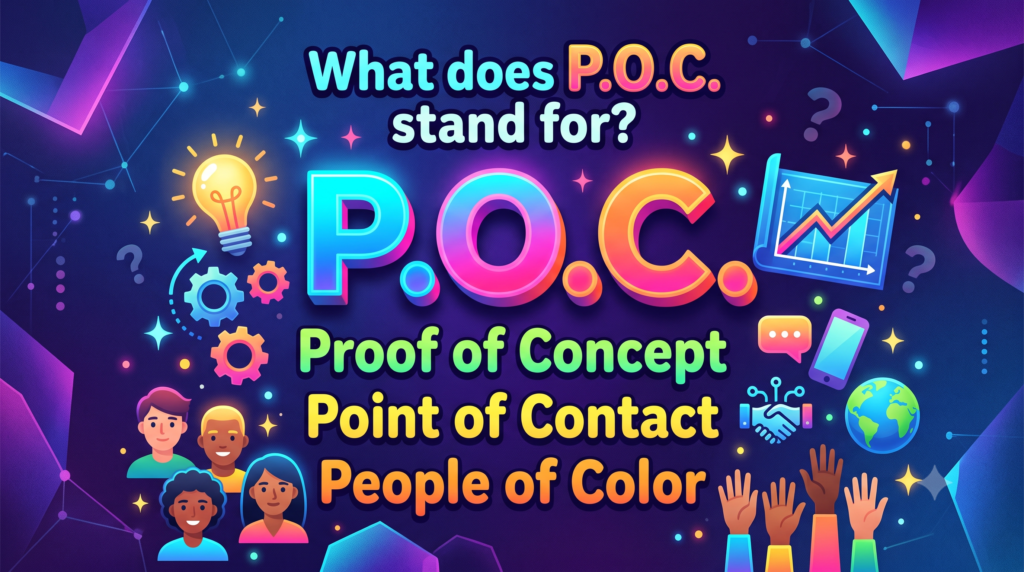
What Does P.O.C. Stand For? Every Meaning Explained With Examples
You are reading an email, a job post, a hospital notice or a project plan, and there it is: POC. If you have ever stopped to ask what does P.O.C. stand for, you are in good company. The abbreviation is short, common and wildly ambiguous. In one meeting it means a person you should call. In the next it means a small experiment to test a new tool. On a social media thread it means something else again.
The honest answer is that P.O.C. has no single full form. The most common meanings are proof of concept, point of contact and person of color, followed by point of care and port of call, plus a long tail of specialist uses. This guide walks through each one, shows where you are likely to meet it, and gives you a simple way to work out which meaning is intended every time. If you work in technology or business, the first two sections will matter most.
Quick Answer: The Main Full Forms of POC
Before the detail, here is a quick-reference table. The same three letters carry very different meanings depending on the field, so context is everything.
| Full form of POC | Where you will see it | What it means in one line |
|---|---|---|
| Proof of concept | Technology, software, startups, product design | A small test that shows an idea can work before full investment |
| Point of contact | Business, projects, government, customer service | The person or team you go to for a specific matter |
| Person or people of color | Social and cultural writing, diversity and inclusion | A term for people who are not white |
| Point of care | Healthcare and diagnostics | Care or testing delivered at or near the patient |
| Port of call | Shipping, cruising and travel | A port where a ship stops during a voyage |
| Percentage of completion | Accounting and construction | A method of tracking progress on a long project |
| Production office coordinator | Film and television | The person who runs the production office |
If you only need a fast answer, that table is it. If you want to understand each meaning properly, keep reading.
POC as Proof of Concept
In business and technology, POC almost always means proof of concept. You will also see it written as PoC, with a lowercase “o”. This is the meaning that readers searching for the POC full form in an office or IT setting usually want.
What a proof of concept means
A proof of concept is a small, focused test that shows whether an idea, method or technology can work in practice. It does not try to build the finished product. It answers one narrow question: is this feasible? If the answer is yes, the team has evidence to justify a larger investment. If the answer is no, the team has spent a little time and money instead of a lot.
A POC is typically limited in scale. It might use a small set of data, a handful of test users or a single workflow. Many run for days or weeks rather than months. The goal is evidence, not polish, which is why a POC often looks rough on the surface.
POC vs prototype vs MVP
These three terms are often mixed up, but they answer different questions.
- A proof of concept asks whether the idea can work at all. It tests feasibility and is usually internal.
- A prototype asks what the product might look and feel like. It shows design and flow, and it is often shown to users and stakeholders.
- A minimum viable product, or MVP, asks whether people will actually use and pay for it. It is a real, working version with only the essential features, released to real users. A sensible order for many projects is POC first, prototype second and MVP third, although teams sometimes skip or combine steps depending on the risk involved.
How to run a proof of concept
A good POC is disciplined about scope. These steps keep it focused.
- Define the question. Write one sentence describing what you need to prove, such as whether a tool can read your invoices accurately.
- Set success criteria before you start. Decide in advance what result counts as a pass, for example an accuracy target or a time saving.
- Limit the scope. Use a small dataset, a small team and a short timeline so the test stays cheap.
- Assign owners. Name who builds it, who evaluates it and who decides what happens next.
- Build and test. Run the experiment and record what works, what breaks and what surprised you.
- Review against the criteria. Compare results to the targets you set, not to a feeling of how it went.
- Decide. Move forward, adjust the approach or stop. A POC that ends with a clear no has still done its job.
A practical example
Imagine a small company that wants to use AI to summarize customer support tickets. Rather than rebuilding its whole help desk, it runs a POC on a few hundred past tickets and checks whether the summaries are accurate enough to be useful. The same thinking applies when teams plan larger automation work, as explained in this guide to building agentic AI applications with a problem-first approach, where starting with a clearly defined problem keeps experiments from drifting. If your team needs help scoping a test like this, a technical consultation is a sensible first step, and a partner offering software development consulting can help turn a successful POC into a working build.
A POC is also a common feature of vendor sales. Technology vendors often offer one to show a buyer that their solution fits a real need before a contract is signed. For the buyer, it is a low-risk way to judge a product on evidence instead of promises.
POC as Point of Contact
The second most common meaning in the workplace is point of contact, sometimes written as POC in emails, contracts and project documents. A point of contact is the person, or the team, designated to handle communication about a specific matter. Instead of asking five people the same question, everyone knows who to ask.
You will see this meaning in phrases like “Please list a POC for your department” or “Who is the POC for this vendor?” It appears in government forms, event planning, IT support, procurement and client services. It is not always a single person. A department, a shared inbox or a team can be the point of contact for a topic.
What makes a good point of contact
- Reachable and responsive, so questions do not stall.
- Knowledgeable enough to answer or to route the question to the right person quickly.
- Clearly named in writing, with a role, email address and backup contact for absences.
- Authorized to make or escalate decisions within the scope of the matter. Naming a point of contact is one of the simplest ways to reduce delays on a project. It removes confusion about ownership and makes accountability visible. In customer-facing work, the same principle drives how teams organize accounts and conversations. Businesses that keep every client interaction tied to a named owner inside a custom CRM automation service can see at a glance who is responsible for each relationship, and the broader discipline of customer relations depends on that same clarity.
POC as Person of Color
Outside the office, POC is widely used as an abbreviation for “person of color” or “people of color.” In British English the spelling is “colour.” The phrase is used to refer to people who are not white, and the abbreviation appears frequently in writing about culture, media, education and workplace diversity.
A few points are worth knowing if you plan to use the term in your own writing.
- The full phrase and the abbreviation are not always received the same way. Some people are comfortable with POC, others prefer to be described by their specific background, and views differ.
- A related term, BIPOC, stands for Black, Indigenous and people of color. It is used to acknowledge the distinct experiences of Black and Indigenous communities, and it is also debated.
- Where it is practical, naming a specific group is usually clearer and more respectful than relying on a broad label.
- In formal documents such as job postings, many organizations spell out the full phrase rather than using the abbreviation, partly because POC can be confused with proof of concept or point of contact. The safest approach is to follow the preference of the people you are writing about or speaking with, and to take the context of your audience into account.
POC as Point of Care
In healthcare, POC means point of care. This refers to care, testing or monitoring that takes place at or near the patient, such as at the bedside, in a clinic or at home, instead of in a central laboratory. Familiar examples include a blood glucose meter and rapid tests that give results within minutes.
The appeal of point-of-care testing is speed. Results available during the same visit can help clinicians and patients make decisions sooner. You will often see the term used as a modifier, as in “POC testing” or “POC device.” Because it sits in the medical field, it is unrelated to the business meanings above, even though the letters match. For a wider look at how technology is changing clinical settings, see this overview of healthcare technology management services.
Other Meanings of POC
Beyond the headline meanings, POC turns up across many specialist fields. Here are the ones you are most likely to meet.
- Port of call: in shipping and travel, a port where a vessel stops during a voyage to load, unload or take on supplies. Outside shipping, people use it loosely to mean a first place to go for something.
- Percentage of completion: in accounting and construction, a method of measuring how much of a long project is finished so that revenue and costs can be recognized as the work progresses.
- Production office coordinator: in film and television, the person who manages the production office and keeps paperwork and logistics moving.
- Paid outside closing: in real estate, an amount paid by a buyer or seller outside the closing process, which is noted on the settlement documents.
- Portable oxygen concentrator: a medical device that delivers oxygen to people who need it while they move around.
- Push to talk over cellular: a service that lets a mobile phone work like a walkie-talkie. It is usually written PoC.
- Proof of concept in security: here a PoC is a demonstration that a vulnerability can actually be exploited. Security researchers use it to show that a flaw is real so that it can be fixed. That last use shows how the same phrase can have a distinct flavor in a specialist field. Security teams rely on this kind of evidence when they assess risk, and a good starting point for understanding the wider topic is this security solutions technology guide.
There are also organization names that share the initials, such as the Philippine Olympic Committee, and the code POC is the IATA code for Brackett Field, an airport in La Verne, California. These are rare and almost always clear from context.
How to Tell Which POC Meaning Is Meant
When you meet POC without an explanation, work through a few quick checks.
- Look at the field. A software roadmap points to proof of concept. A hospital notice points to point of care. A shipping schedule points to port of call.
- Look at the grammar. “Please send this to the POC” suggests point of contact, because it refers to a person or role. “We ran a POC last month” suggests proof of concept, because it refers to a test or project.
- Look at the surrounding words. Terms like pilot, feasibility, scope and success criteria signal proof of concept. Terms like escalate, contact details and owner signal point of contact.
- Look at who is speaking. A vendor offering a POC usually means a trial. A manager asking for a POC usually wants a name.
- When it is still unclear, ask. A one-line question costs less than acting on the wrong meaning. If you are writing for others, avoid the problem altogether. Spell out the full phrase the first time you use it and put the abbreviation in brackets, then use POC afterward. This is standard practice in clear business writing and in documentation of all kinds, and it matters for readers who may only know one of the meanings. It is the same principle behind well-structured SEO content strategy: define terms for readers first.
POC, PoC and P.O.C.: Does the Style Matter?
The abbreviation appears in several forms, and the differences are mostly habit. “POC” in capitals is the most common form across all meanings. “PoC” with a lowercase o is popular in technology for proof of concept, and it is also used for push to talk over cellular. “P.O.C.” with periods is an older style that you will still see in some documents and dictionaries, and it is the form that many people type when they search for the meaning.
None of these forms changes the meaning on its own. Choose one style and stay consistent inside a single document. If your company has a style guide, follow it.
Frequently Asked Questions About POC
What does POC stand for in business?
In business, POC most often stands for either proof of concept, meaning a small test of an idea, or point of contact, meaning the designated person for a matter. The surrounding sentence usually makes it clear which one is intended.
What does POC stand for in IT and software?
In IT and software it stands for proof of concept, a limited experiment that checks whether a technology or approach is feasible before a full build. In security, a PoC can also mean a demonstration that a vulnerability can be exploited.
What does POC mean in a text message or on social media?
In informal and social settings it most commonly means person of color or people of color. If you are not sure and the context does not make it clear, it is fine to ask.
Is a POC the same as a prototype?
No. A proof of concept tests whether an idea is feasible, while a prototype shows how a product might look and behave. A POC can come before a prototype, and neither is a finished product.
How long does a proof of concept take?
There is no fixed length, but a POC is meant to be short and focused, often days to a few weeks. If it keeps growing, the scope is probably too large.
What does POC mean in healthcare?
In healthcare it means point of care, referring to care or testing delivered at or near the patient, such as a bedside blood glucose check.
Conclusion: Always Read POC in Context
So, what does P.O.C. stand for? It depends on where you are. In technology it is usually proof of concept, in the office it is often point of contact, in cultural conversations it is commonly person of color, and in medicine it is point of care. A handful of other fields add their own meanings.
The best habit is simple: check the context, spell the phrase out when you write, and keep your abbreviation style consistent. If you are weighing a new tool or system and want a clear plan for testing it, the team at The Cloud Republic can help you scope a proof of concept and take it from idea to launch. You can contact The Cloud Republic to talk through your project.