
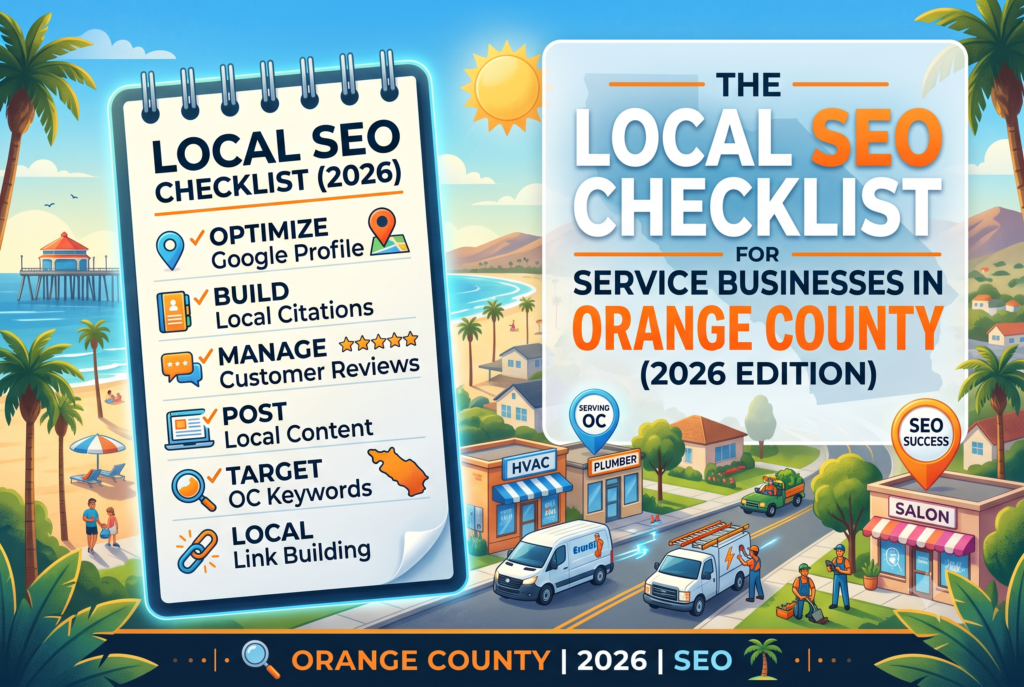
The Local SEO Checklist for Service Businesses in Orange County (2026 Edition)
Title tag: Local SEO Checklist for Service Businesses in Orange County | The Cloud Republic (58 characters)
Meta description: A step by step local SEO and Google Business Profile checklist built for Orange County service businesses, covering GBP, citations, reviews, schema, and AI search visibility. (152 characters)
URL slug: /local-seo-checklist-service-businesses-orange-county/
By The Cloud Republic Team | Last reviewed August 2026
If you run a plumbing company in Costa Mesa, a family law practice in Newport Beach, or an HVAC business in Irvine, most of your new customers are finding you the same way: they search on Google, look at the map results, and call one of the first three businesses they see. If your business is not one of those three, you are losing work to a competitor who simply has a better optimized Google Business Profile and a more complete local SEO foundation.
This checklist covers everything that actually moves local rankings for Orange County service businesses in 2026: your Google Business Profile, your website, your citations and reviews, your schema markup, and increasingly, how your business shows up in AI Overviews and other AI powered answers. Work through it section by section, or use it as a reference to audit what you already have in place.
Why Local SEO Matters for Orange County Service Businesses
Google ranks local businesses using three main factors: relevance (how well your listing matches what someone searched for), distance (how close you are to the searcher), and prominence (how well known and well reviewed your business is). A Santa Ana electrician and an Anaheim electrician are often competing for the exact same searcher, since Orange County cities sit close together and service areas overlap constantly. That makes the difference between showing up in the map pack and not showing up often come down to small, fixable details: a specific business category, a complete profile, consistent business information, and a website that backs up what your Google Business Profile says.
Search itself is also changing. Google’s AI Overviews and AI Mode now answer many local queries directly, pulling from the same core ranking systems that power regular search results. This checklist treats classic local SEO and AI search visibility as one connected job, not two separate projects, because that is how Google’s own search systems actually work.
Step 1: Claim, Verify, and Fully Build Out Your Google Business Profile
Your Google Business Profile, or GBP, is the single highest leverage asset in local SEO. It is what shows up in the map pack, on Google Maps, and increasingly inside AI generated answers. Start here before touching anything else on this list.
Claim and verify your profile
Search for your business on Google Maps. If a listing already exists, claim it. If not, create one at business.google.com. Verification happens by postcard, phone, email, or video, depending on your business type, and your profile will not appear in search results until it is verified.
If you are a service area business, such as a mobile pet groomer or a plumber who drives to customers rather than welcoming them to an office, select that option during setup. This lets you hide your home address and instead list up to 20 service areas by city or zip code, which is the correct setup for most home service businesses operating across Orange County.
Choose the most specific category available
Your primary category is one of the strongest signals Google uses to decide which searches you are eligible to show up for. Go as specific as your business genuinely supports. A Santa Ana law firm should choose Personal Injury Attorney rather than the broader Attorney if that is the actual specialty. An Irvine HVAC company should choose HVAC Contractor rather than Contractor. Look at what your top three competitors in the map pack are using, since a more specific category is often the reason a smaller competitor is outranking you.
You can add secondary categories as well. Add every category that genuinely describes a service you offer, and nothing you do not actually provide. Adding categories for services you do not perform violates Google’s guidelines and puts your listing at risk of suspension.
Complete every field
- Business name that matches your real world signage exactly, with no keywords added
- Address and phone number that match your website and citations exactly
- Accurate business hours, including holiday hours
- A business description using the full 750 characters available, with the most important information in the first 244 characters since that is what shows before the description is truncated
- A complete services and products list with descriptions, so Google can match your profile to specific searches like emergency water heater repair
- Attributes that apply to your business, such as women owned, veteran owned, or wheelchair accessible
Photos and posts
Businesses with more photos consistently get more calls and direction requests than businesses with few or none. Upload at least ten photos to start, covering your storefront or team, completed work, and your service area, then add new photos monthly. Google Posts work similarly to a small social feed attached to your profile. They expire after seven days, so posting weekly keeps your profile looking active, which is itself a signal Google and customers both respond to.
Seed your Q&A section
The Q&A section on your GBP listing is public and frequently overlooked. Add the five to ten questions customers actually ask you on the phone every week, such as whether you offer same day service or what areas you cover, and answer them yourself before someone else posts an inaccurate answer. This section also feeds directly into how AI search tools understand and summarize your business, which makes it useful for both classic local SEO and the AI visibility work covered in Step 7.
Step 2: Build Real Experience, Expertise, Authority, and Trust Into Your Profile and Website
This is the step most local SEO checklists skip, and it is also where a lot of Orange County service businesses can pull ahead of competitors with a thinner web presence. Google’s own guidance on generative AI search is explicit that unique, first hand content outperforms generic advice that could have come from anywhere. A templated local SEO checklist copied across a hundred service business websites is exactly the kind of content that does not stand out.
Show who is actually doing the work
- List real staff names, roles, and relevant credentials such as a contractor’s license number, a bar number, or a trade certification
- Use real photos of your team and your actual completed jobs instead of stock photography
- Include how long you have served Orange County specifically, not just a general founding date
- Write staff bios or an about page that reads like it was written by someone who actually works there
Point to real, first hand results
A single detailed example carries more weight than five generic claims. Instead of writing that you provide excellent service, describe an actual project: a same day repair for a Tustin homeowner during a heat wave, or a kitchen remodel completed for a client in Costa Mesa within a specific timeframe. Details like this are hard to fake and hard for a competitor to copy, which is exactly what makes them useful for ranking and for AI systems trying to decide which sources are trustworthy enough to cite.
This is also a natural place to point readers toward our team’s Orange County web design and SEO work, since it shows the same first hand approach applied to your own site.
Step 3: Fix NAP Consistency and Build Local Citations
NAP stands for name, address, and phone number. Google cross references this information across the web to confirm your business is legitimate, and inconsistencies between listings are one of the most common, and most fixable, local SEO problems. A business listed as 123 Main Street on its website and 123 Main St on Yelp is sending Google a small but real signal that something does not quite match.
Create a single source of truth
Write down your exact business name, complete address in one standardized format, and primary local phone number in a single document. Use this as the reference for every directory and platform going forward.
| Element | Correct format | Avoid |
|---|---|---|
| Street type | 123 Main Street | 123 Main St, 123 Main St. |
| Suite or unit | Suite 200 | Ste 200, #200, Unit 200 |
| Phone number | (714) 555 0100 | 714-555-0100, 714.555.0100 |
Build citations in priority order
- Tier 1: Google Business Profile, Apple Maps, Bing Places, Yelp, Facebook Business Page
- General directories: Better Business Bureau, Yellow Pages
- Orange County specific: Orange County Chamber of Commerce, Discover Orange County business listings, and your city’s local chamber if you have one
- Industry specific: Angi and Houzz for home services, Avvo for legal, Healthgrades for medical, RepairPal for auto
- Data aggregators: Data Axle, Neustar Localeze, and Foursquare, which feed hundreds of smaller directories automatically
Audit your listings quarterly. Fixing NAP inconsistencies is one of the fastest, lowest cost improvements available, since it usually requires no new content, only correcting what already exists.
Step 4: Optimize Your Website’s Local On-Page SEO
Your Google Business Profile gets you into the map pack. Your website is what convinces both Google and the customer that you are legitimate once they click through.
Title tags and meta descriptions
Work your primary service and city into the title tag naturally, without stuffing in every city you serve. Emergency Plumber in Costa Mesa, CA reads naturally and tells Google exactly what the page is about. Meta descriptions should read like a reason to click, not a keyword list.
Build real service pages, not templated city swaps
Create a separate page for each core service rather than one page that tries to cover everything. A roofing company should have distinct pages for roof repair, roof replacement, and roof inspections, each with at least 500 words of genuinely unique content. Google’s helpful content systems are specifically built to detect thin pages where only the city name changes between otherwise identical templates, so each page needs real, specific detail: pricing ranges, the process you follow, and the kinds of problems you actually solve.
Location and service area pages
If you serve multiple Orange County cities, such as Irvine, Santa Ana, Anaheim, Costa Mesa, and Newport Beach, create a dedicated page for each one you genuinely serve, not every city in the county. Each page needs unique local detail: a neighborhood you commonly work in, a landmark near your service area, or a challenge specific to that city, such as older plumbing common in a particular part of Santa Ana. Embed a Google Map, keep your NAP visible in the footer, and make sure your phone number is tap to call on mobile.
If your current site is built on templated pages with only the city swapped, a custom rebuild is usually the fastest way to fix this properly rather than patching individual pages.
Step 5: Add LocalBusiness and FAQPage Schema Markup
Structured data helps your pages qualify for rich results in search, and it gives Google explicit, unambiguous information about your business rather than making Google infer it from page text. It is worth doing well, though it is worth being accurate about its limits too: Google’s own generative AI search guidance states plainly that structured data is not required for AI visibility, and that there is no special schema needed just for AI Overviews. Add it because it is good practice and helps with rich results, not because it is a shortcut to ranking in AI answers.
LocalBusiness schema example
{
  "@context": "https://schema.org",
  "@type": "HVACBusiness",
  "name": "Your Business Name",
  "address": {
    "@type": "PostalAddress",
    "streetAddress": "123 Main Street",
    "addressLocality": "Irvine",
    "addressRegion": "CA",
    "postalCode": "92602",
    "addressCountry": "US"
  },
  "telephone": "+1-714-555-0100",
  "openingHours": "Mo-Fr 08:00-18:00",
  "areaServed": ["Irvine", "Santa Ana", "Costa Mesa", "Newport Beach"],
  "url": "https://www.yourbusiness.com"
}
Use the most specific type available, such as HVACBusiness, PlumbingContractor, or LegalService, rather than the generic LocalBusiness where a more precise option exists.
FAQPage schema example
{
  "@context": "https://schema.org",
  "@type": "FAQPage",
  "mainEntity": [{
    "@type": "Question",
    "name": "Do you offer same day service in Orange County?",
    "acceptedAnswer": {
      "@type": "Answer",
      "text": "Yes, same day appointments are available for most Orange County service areas when booked before 2pm."
    }
  }]
}
Match this markup to the FAQ section near the end of this page, and validate both blocks with Google’s Rich Results Test before publishing.
Step 6: Collect and Respond to Reviews the Right Way
Reviews influence both your ranking and whether a customer actually calls you instead of a competitor. Prominence, which includes review volume, quality, and recency, is one of Google’s three core local ranking factors.
- Ask for a review within 24 to 48 hours of finishing a job, while the experience is still fresh
- Send a direct review link by text or email rather than asking customers to search for you
- Respond to every review, positive and negative, within a couple of days
- For a negative review, acknowledge the issue, avoid arguing publicly, and offer a direct way to resolve it offline
- Never offer discounts or incentives in exchange for a review, and never gate requests to only satisfied customers, since both violate Google’s policies and put your listing at risk
A steady flow of new reviews matters more than chasing a perfect star rating. A business with a 4.6 rating and new reviews every week typically outperforms a business with a 5.0 rating and nothing new in six months, because recency itself is a signal.
Step 7: Optimize for AI Overviews and Answer Engines
A growing share of local searches are now answered directly inside Google’s AI Overviews and AI Mode, along with tools like ChatGPT and Perplexity. Google has been clear that for Google Search specifically, this is not a separate discipline from SEO: AI Overviews are built on the same core ranking systems as regular search results, using retrieval augmented generation to pull from pages already ranking well and query fan out to cover related questions a searcher might have. Optimizing for AI visibility in Google Search means optimizing for search, full stop.
What actually helps
- Open each page or section with a complete, standalone sentence that directly answers the question the heading asks, before adding supporting detail
- Use question shaped subheadings that match how customers actually ask, such as How much does emergency plumbing cost in Irvine, rather than generic headers like Our Pricing
- Confirm your robots.txt is not blocking known AI crawlers if you want your content eligible for AI features, though this is a technical baseline, not a ranking boost on its own
- Keep building unique, first hand content, per Step 2, since Google’s generative AI guidance specifically calls out original point of view as the strongest long term signal
Two myths worth retiring
A lot of AEO advice circulating online has not caught up with Google’s own guidance. Two are worth correcting directly, since believing them wastes time that would be better spent elsewhere.
- An llms.txt file does nothing for Google Search. Google has stated plainly that it does not use llms.txt or similar machine readable files, and creating one will neither help nor hurt your visibility in Google Search or its AI features.
- Chunking your content into small fragments is not required. Google’s systems can understand the nuance of a full page and surface the relevant part to a user without you needing to break content into artificially short pieces.
Focus instead on what Google actually says matters: clear, well organized content written for your actual customers, with genuine expertise behind it.
Step 8: Build Local Links and Community Signals
- Join your local Orange County chamber of commerce, which typically includes a website link
- Sponsor a local sports team, school program, or community event
- Cross refer with complementary local businesses, such as a roofer partnering with a gutter company
- Sign up for HARO or Connectively to get quoted as a local expert in relevant articles
- Pitch a local news outlet on a genuine community story, not a press release about routine business updates
Avoid paid link schemes, private blog networks, and large scale reciprocal linking. These carry real penalty risk and rarely hold up over time.
DIY vs. Hiring a Local SEO Partner in Orange County
Most of this checklist is genuinely doable in house. Where businesses tend to get stuck is the ongoing work: ongoing content, multi city tracking, and technical fixes that require development time.
| Task | Typical DIY time | When to bring in help |
|---|---|---|
| GBP setup and optimization | 2 to 4 hours one time, plus 30 minutes weekly | Rarely needed unless you manage 5+ locations |
| Citation building and NAP cleanup | 4 to 8 hours initially, quarterly upkeep | Helpful once you have 50+ directories to manage |
| Service and location pages | Several hours per page if writing yourself | Common to outsource for a full rebuild |
| Schema markup | 1 to 2 hours with a template | Worth outsourcing if your site has no developer access |
| Ongoing content and technical SEO | Several hours weekly, indefinitely | Where most businesses eventually bring in support |
If you would rather have this handled for you, our SEO services cover the full checklist above, and the Digital Growth Blueprint combines it with website and automation work for Orange County service businesses that want it all done together.
Track What’s Actually Working
- Google Search Console, to see which queries you rank for and whether your local pages are indexed
- Google Analytics 4, to track traffic and conversions such as calls and form submissions
- Google Business Profile Insights, to see calls, direction requests, and website clicks directly from your listing
- The Generative AI performance report in Search Console, which shows how your content is performing specifically in AI Overviews and other generative features
Review these monthly. A quarterly only check often means a dropped listing or a broken NAP match goes unnoticed for weeks before it shows up as lost calls.
Frequently Asked Questions
How long does local SEO take to show results in Orange County?
Most Orange County service businesses see initial movement within 60 to 90 days of a complete Google Business Profile and NAP cleanup, with fuller results over 4 to 6 months. Highly competitive categories such as personal injury law or HVAC in dense cities like Irvine or Santa Ana typically take longer than a niche service in a smaller city.
Is Google Business Profile really free?
Yes. Claiming, verifying, and fully building out your Google Business Profile costs nothing. Paid tools can help with tracking and citation management at scale, but the profile itself is free.
Do I need a separate page for every Orange County city I serve?
Only for cities you genuinely and regularly serve, and only if you can write real, unique content for each one. A thin page with only the city name changed is more likely to hurt you than help, since Google’s helpful content systems are built to detect that pattern.
How many Google reviews do I need to rank in the map pack?
There is no fixed number. Check what your top three local competitors currently have and treat that as your benchmark, since review volume is relative to your specific category and city rather than a universal threshold.
Can I pay Google for a better local ranking?
No. Google has stated directly that there is no way to pay or request a better local ranking. Rankings are based on relevance, distance, and prominence, not advertising spend.
What is the difference between local SEO and AEO?
For Google Search specifically, they are not separate disciplines. Google’s AI Overviews and AI Mode draw from the same core ranking systems as regular search results, so the local SEO work in this checklist, a complete profile, consistent citations, genuine reviews, and clear content, is also what supports AI search visibility.
Do I need an llms.txt file to show up in AI Overviews?
No. Google has stated plainly that it does not use llms.txt or similar files for Google Search, including its AI features. Creating one will not help or hurt your visibility on Google.
How often should I post on Google Business Profile?
At least once a week. Posts expire after seven days, so weekly posting keeps your profile looking active, which is a signal Google and customers both respond to.
What is the single biggest local SEO mistake Orange County service businesses make?
Treating Google Business Profile as a one time setup task instead of an ongoing one. Profiles that go months without a new photo, post, or review tend to lose ground to competitors who stay active.
Should I hire a local SEO agency or do it myself?
Most of this checklist is doable in house with time and consistency. Businesses typically bring in outside help for ongoing content production, multi city tracking, and technical fixes that require development work.
Your Next Local SEO Move
Local SEO for an Orange County service business is not a one time project. It is an ongoing system: a Google Business Profile that stays current, a website that backs it up, reviews that keep coming in, and content that reflects real, first hand expertise rather than generic advice. Work through this checklist in order, starting with your Google Business Profile, and revisit it quarterly.
If you would rather have an experienced team handle it, get in touch with The Cloud Republic and we will walk through exactly where your current setup stands and what would move the needle fastest.