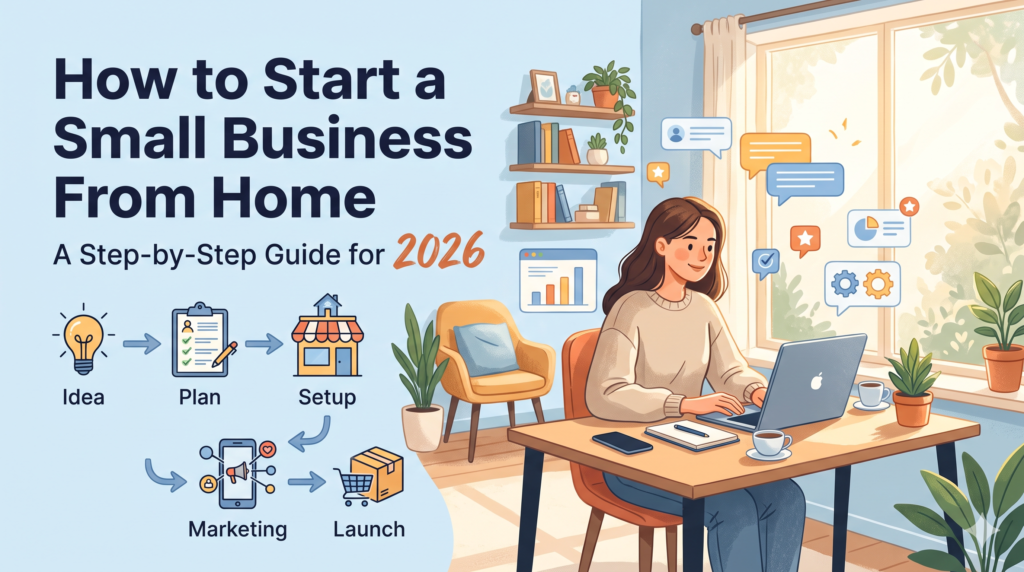
Starting a business from your spare room, kitchen table or laptop is one of the lowest-risk ways to become your own boss. There is no lease to sign, no commute to pay for, and you can test an idea before you commit serious money to it. The hard part is not the idea. It is knowing what to do first, what can wait, and which rules apply to you.
This guide shows you how to start a small business from home in 12 practical steps. A home-based business is simply one where your home is the main place the work happens, whether you serve clients online, travel to customers or ship products from a spare room. Along the way you will get a startup cost worksheet, a permit and insurance checklist, a plain-English look at taxes, and a 30-60-90 day plan you can follow. If you are still unsure what counts as a small business, that guide explains the definitions before you begin.
Permit, tax and insurance rules vary by state, county and city, so treat this guide as a map and confirm local details with the agencies named below.
Key takeaways
- Validate demand with real target customers before you spend money on branding or a website.
- Check zoning, lease or HOA rules and insurance before you take your first customer.
- Keep business money separate from personal money from day one.
- Choose two marketing channels, launch small, and measure what works.
Is Starting a Small Business From Home Right for You?
A home-based business suits many people, but it is not effortless. Be honest about both sides before you commit.
| Benefits | Trade-offs |
|---|---|
| Lower overhead than a shop or office | You need self-discipline with no boss or fixed schedule |
| Flexible hours and no commute | Work and home life blur unless you set boundaries |
| Cheaper to test an idea | Zoning, HOA or lease rules may limit what you can do |
| Grow at your own pace | No foot traffic, so marketing is entirely your job |
| Keep your job while you build | You can outgrow your space sooner than expected |
Run through this short self-check:
- How many hours per week can you realistically give the business?
- How many months of expenses could you cover if income arrives slowly?
- Do you have a quiet space that can be used mostly for work?
- Are you comfortable with uneven income in the first months?
- Will you keep your current job while you launch, or leave right away?
If the answers feel manageable, you are ready to move on. Running a business also rewards habits you can build over time, and the entrepreneurial skills you can build along the way cover the ones that matter most.
Step 1: Choose a Business Idea That Works From Home
The best home business ideas sit where three things meet: a skill you already have, a problem people will pay to solve, and a model that does not need a storefront. Start by asking what friends, family and former colleagues already ask you for help with. That is often a clue to a service people value.
Service-based ideas
Services are usually the cheapest way to start a business from home because you sell your time and skill rather than inventory. Common examples include bookkeeping, virtual assistance, freelance writing, graphic design, web design, tutoring, social media management and consulting. A laptop, reliable internet and a clear offer are often enough to begin.
Product-based ideas
Handmade goods, print-on-demand items and reselling can work well from home, but they bring storage, shipping, packaging and sometimes product safety rules. Count those costs before you decide.
Digital products and coaching
Online courses, templates, e-books and coaching let you sell what you know to many people. They take effort to create up front, but once built they can be sold repeatedly without making new stock.
| Idea type | Startup cost level | Home fit | Main risk |
|---|---|---|---|
| Services such as bookkeeping or design | Low | Excellent | Trading hours for income, so growth needs systems |
| Handmade or resale products | Medium | Good if you have storage | Inventory, shipping and product rules |
| Print-on-demand or dropshipping | Low to medium | Excellent | Thin margins and heavy competition |
| Digital products and coaching | Low | Excellent | Slow start while you build an audience |
| Food production | Medium | Limited by local rules | Health codes and permits |
Be cautious with ideas that need heavy equipment, create noise or traffic, or depend on walk-in customers. Those often clash with residential zoning. If you are drawn to a visual service, the guide on how to start a photography business is a useful worked example of turning a skill into a service.
Step 2: Validate Demand and Research Competitors
Passion is a good start, but customers pay the bills. Before you invest, test whether real people want what you plan to sell.
- Define your target customer. Write one short profile: who they are, what problem they have and where they look for help.
- Scan the competition. Search for businesses offering something similar, locally and online. Note their prices, their offers and what customers complain about in reviews.
- Check search demand. Free tools such as Google Trends show whether interest is growing or fading. A content strategy built around real search demand uses the same idea to decide what to publish.
- Talk to three to five target customers. Ask about the problem, not your idea. Friends and family tend to praise, so seek out people who actually fit your audience.
- Write a one-sentence value promise. For example: “I help small clinics keep their books clean so they can file taxes without stress.” If you cannot say it simply, the idea is not clear yet.
Set a go or no-go rule before you start. For example, proceed only if some of the people you speak to are willing to pay, pre-order or join a waiting list. A polite “sounds interesting” is not evidence of demand.
Step 3: Write a One-Page Business Plan and Startup Budget
You do not need a 40-page document. A one-page plan keeps you focused and is enough to guide early decisions. Cover these points:
- Offer: what you sell and who it is for.
- Audience: the customer profile from Step 2.
- Pricing: how much you charge and why.
- Marketing: the two channels you will start with.
- Budget: what you need to spend before the first sale.
- Three-month goals: a small number of measurable targets.
Startup costs vary widely by business type, and many widely quoted averages are dated. Instead of trusting a generic number, collect current quotes and fill in your own worksheet.
| Category | One-time cost | Monthly cost | Notes |
|---|---|---|---|
| Computer and equipment | |||
| Internet and phone | |||
| Software and subscriptions | |||
| Website and domain | |||
| Licenses and permits | |||
| Insurance | |||
| Supplies or inventory | |||
| Marketing |
Add up the monthly column, then divide your available savings by that total to estimate your runway in months. Once the plan is written, the next question is execution, and this roadmap on what to do after your business plan is written helps you turn it into action.
Step 4: Check Zoning, Permits, Lease Rules and Insurance
Working from home does not exempt you from local rules. A few phone calls now can prevent fines or a forced shutdown later.
- Zoning and home occupation permits. Many cities and counties require a home occupation permit and limit things like employees on site, customer visits, signage and deliveries. Check with your city or county planning office.
- HOA and lease rules. If you rent or live in an HOA community, read the agreement. Some restrict business activity, customer visits or outdoor signs.
- Health rules for food. If you plan to sell food made at home, check your state and local food rules before you cook anything for sale.
- Business license and sales tax permit. Many places require a general business license, and if you sell taxable goods you may need a sales tax permit from your state.
- Insurance. Standard homeowners and renters policies often limit or exclude business activity. Ask your insurer what is covered, and whether you need an endorsement or a separate business policy.
| Item | Who to ask | When |
|---|---|---|
| Zoning and home occupation permit | City or county planning office | Before you start |
| HOA or lease restrictions | HOA board or landlord | Before you start |
| Business license | City, county or state business office | Before your first sale |
| Sales tax permit | State tax agency | Before selling taxable goods |
| Food handling rules | Local health department | Before selling food |
| Insurance coverage | Your insurance agent | Before your first customer |
The Small Business Administration also offers a permits and licenses guide with a tool to see what your area requires.
Step 5: Choose a Business Structure and Register
Your structure affects your taxes, your personal liability and your paperwork. Most home businesses start as one of two types.
| Structure | Liability protection | Setup effort | Tax treatment | Best for |
|---|---|---|---|---|
| Sole proprietorship | None, you and the business are the same | Very low | Profit reported on your personal return | Freelancers and low-risk side businesses |
| LLC | Separates personal assets from business debts | Moderate, with a state filing fee | Flexible, often taxed like a sole proprietorship by default | Businesses with clients, contracts or higher risk |
A sole proprietorship is the easiest way to start, but it leaves your personal assets exposed if something goes wrong. An LLC adds protection and credibility at the cost of paperwork and annual state fees, which vary by state. S corporations and C corporations exist, but most home businesses do not need them until they grow.
If you trade under a name other than your own, you may need to file a DBA (doing business as) with your state or county. An Employer Identification Number (EIN) is free from the IRS. You generally need one if you hire employees or form an LLC with other owners, and many sole proprietors get one anyway so they do not have to share their Social Security number with clients. Confirm your own situation on the IRS website, because the rules depend on how you operate.
Step 6: Separate Your Finances and Understand Taxes
Open a business bank account before your first payment arrives. Keeping business and personal money apart makes bookkeeping, taxes and budgeting far easier, and it protects you if your records are ever questioned. Pair the account with simple bookkeeping software or a spreadsheet and save every receipt.
Not tax advice. The points below are general information. Tax rules change and depend on your situation, so confirm details with the IRS and a qualified accountant before you file.
Self-employment tax. If your net earnings from self-employment reach $400 or more, you generally owe self-employment tax, which covers Social Security and Medicare. The rate is 15.3% on 92.35% of your net earnings, and you can deduct half of it when you figure your income tax.
Estimated taxes. There is no employer withholding for self-employed people. If you expect to owe $1,000 or more in federal tax for the year, you generally pay estimated taxes quarterly, with due dates around April 15, June 15, September 15 and January 15.
Home office deduction. If you use part of your home regularly and exclusively for business, you may be able to deduct it. The IRS offers two methods:
| Simplified method | Regular method | |
|---|---|---|
| How it works | $5 per square foot of business space | Actual expenses for the business share of your home |
| Space limit | Up to 300 square feet, so a maximum of $1,500 | Percentage of home used for business |
| Records | Square footage only | Actual expense records |
| Depreciation | None | Allowed for the business portion |
For both methods, the deduction cannot exceed the income the business earns from that use of your home. A qualified accountant can tell you which method gives the better result and help you file correctly.
Step 7: Set Up Your Workspace and Tools
A small amount of structure keeps a home business from taking over your house. Choose a dedicated space, even if it is only a corner with a desk and a door you can close. Set work hours and stick to them, because the habit of finishing is as important as the habit of starting.
- Workspace: a quiet area, a comfortable chair, good lighting and storage for supplies or records.
- Equipment: a reliable computer, fast internet and a phone number you can keep separate from personal calls.
- Tools by category: project management (Trello, Asana or Notion are common examples), invoicing and payments (Stripe, PayPal or Square), and shared documents and email.
- Security: a password manager, regular backups and a separate business email address.
Picking tools can become a time sink, so choose one in each category and revisit later. A good overview of productivity software can help you compare options without buying more than you need.
Step 8: Build a Website People Trust
Your website is your storefront. Even if most customers find you through referrals, they will search for you before they pay. A simple, clear site is enough to start.
Pages to include: a home page that states what you do and who you serve, an about page that builds trust, a services or products page, and a contact page with a form and clear contact details. Write a clear page title and meta description for each page so people know what they will find in search results. Add real photos, customer reviews and clear pricing or next steps wherever you can.
Make sure the site works well on a phone and loads quickly, since slow pages cost you visitors. This is covered in more depth in the article on website speed and why it matters for winning clients.
| DIY website builder | Hire a designer | |
|---|---|---|
| Cost | Low monthly fee | Higher up front |
| Time | Days to a few weeks | Depends on scope and the designer |
| Control | Full, within the builder’s limits | Full design control |
| Best for | Simple service sites and small shops | Custom features, branding or growth plans |
If you want to build it yourself, this step-by-step guide to making a website walks through the process, and the overview of the drag-and-drop website builder approach explains what to expect from those tools.
Step 9: Get Found Locally and Online
If customers cannot find you, they cannot hire you. A few basics make a large difference, especially for businesses that serve a local area.
- Claim a Google Business Profile. Home-based businesses are generally eligible if they serve customers in person or travel to them. If you do not meet customers at your home, set the profile up as a service-area business and hide your home address instead of showing it, and list the areas you serve. Google uses your real address for verification, and showing an address you do not operate from can put the profile at risk of suspension. Read Google’s current guidelines before you set it up, because the details change.
- Keep your details consistent. Use the same business name, phone number and website everywhere you are listed.
- Collect reviews. Ask happy customers to leave an honest review after each job.
- Use location and service terms naturally. Page titles such as “Bookkeeper for dental clinics in Austin” tell both people and search engines what you offer.
- Answer customer questions. Short, useful articles and service pages help new customers trust you before they call.
If you want to understand the bigger picture, this guide on what SEO services involve explains how search visibility is built. For a practical example of local steps, the local SEO checklist for service businesses is written for Orange County, but the same principles apply anywhere.
Step 10: Market Your Business and Win Your First Customers
Marketing from home means you do all of it yourself, so pick a small number of channels and do them well. Two is enough at first.
| Channel | Best for | Effort |
|---|---|---|
| Referrals and personal outreach | Services and local businesses | Low cost, steady effort |
| Social media | Visual products and personal brands | Regular posting |
| Repeat customers and courses | Build a list over time | |
| Paid ads | Fast tests once your offer is proven | Budget and monitoring |
For your first ten customers, start with people who already know and trust you, then ask for introductions. A launch offer, such as a limited-time discount or a free consultation, gives people a reason to act now. Do not underprice to win work. Very low prices attract customers who leave quickly and make it harder to raise rates later.
You can also choose between a soft launch to a small group, which lets you fix problems quietly, and a full launch across all your channels, which creates more attention but less room for error. Most home businesses benefit from a soft launch first.
For a broader view of the options, the guide to digital marketing for small businesses covers the main channels. If you plan to run ads, the overview of internet advertising platforms compares where to spend. And if social media is your main channel, you can learn how to automate Instagram posts so you stay consistent without living on your phone.
Step 11: Put Simple Systems and Automation in Place
When you are the whole team, small repeated tasks eat your day. A few simple systems prevent leads and invoices from slipping through the cracks.
- Track from day one: every lead, quote, invoice and follow-up.
- Start simple: a spreadsheet is fine at the beginning. Move to a CRM when you can no longer remember who needs a reply.
- Automate what repeats: booking, onboarding messages, reminders and follow-up emails.
- Fix the process first: automate only after the steps work reliably by hand.
The overview of small business automation shows where automation saves the most time. If you are choosing software, the comparison of the best CRMs for service-based small businesses helps narrow the list. For a concrete workflow, see how to automate client onboarding, follow-ups and booking.
Step 12: Launch, Measure and Grow
Launch to a small audience first, collect feedback, and improve before you scale. Then track a handful of numbers so you know what is working.
| Metric | What it tells you | How often to check |
|---|---|---|
| New leads | Whether your marketing reaches people | Weekly |
| Conversion rate | How many leads become paying customers | Monthly |
| Revenue | Whether the business can support you | Monthly |
| Cost to win a customer | Whether your marketing is worth the spend | Monthly |
Ask early customers what worked and what did not, and ask permission to share their feedback as testimonials. As demand grows, you can hire a freelancer for tasks you dislike or do slowly, raise prices, or eventually move out of your home when zoning or space becomes a limit. If you want proven ideas to lift your results, this guide on how to boost sales performance is a good next read.
Common Mistakes to Avoid
- Skipping validation. Fix it by talking to real customers before spending money.
- Ignoring permits and insurance. Fix it by making the Step 4 calls early.
- Mixing personal and business money. Fix it with a separate account from day one.
- Underpricing. Fix it by pricing for the value you deliver and the time you spend.
- Having no marketing plan. Fix it by choosing two channels and committing to them.
- No boundaries between work and home. Fix it with set hours and a defined workspace.
Your 30-60-90 Day Launch Plan
| Phase | Key tasks | Finish line |
|---|---|---|
| Days 1 to 30 | Validate the idea, check permits and insurance, choose a structure, open a business bank account, fill in the startup cost worksheet | You have a validated idea and are legally ready to take a customer |
| Days 31 to 60 | Build your website, claim your Google Business Profile, run a pilot with your first customers | You have a live website and at least one paying or pilot customer |
| Days 61 to 90 | Launch, start your two marketing channels, set up simple systems, review the numbers | You have a repeatable way to find customers and a list of what to improve |
Frequently Asked Questions
How do I start a small business from home with no money?
Choose a service you can deliver with tools you already own, such as bookkeeping, writing, design or tutoring. Skip paid branding and ads at first, pre-sell to a few customers, and reinvest early income. Only pay for what a legal requirement or a customer demands.
What is the cheapest business to start from home?
Service businesses usually cost the least because they need no inventory. Freelancing, virtual assistance and consulting often need only a computer, internet and a way to get paid. The cheapest option for you is the one that uses skills you already have.
Do I need an LLC to start a business from home?
No, you can start as a sole proprietor. An LLC adds liability protection and credibility, so it is worth considering if you work with clients, sign contracts or handle higher-risk work. Compare the cost in your state and speak with an accountant or attorney.
Do I need a license to run a business from my home?
It depends on your location and business type. Many cities require a general business license or a home occupation permit, and some professions need their own license. Contact your city, county and state business offices to confirm what applies to you.
Can I start a home business while working a full-time job?
Yes, and it is a smart way to reduce risk. Check your employment contract for conflict-of-interest or moonlighting rules, work on the business in your own time and on your own equipment, and keep a steady paycheck until the business income is reliable.
How long does it take to start a business from home?
Many people can complete the basic setup in about 90 days using the plan above. Simple service businesses can start sooner, while product businesses and those that need permits or licenses often take longer.
Conclusion and Next Step
Starting a small business from home comes down to a simple sequence: choose an idea, prove people want it, handle the legal and financial basics, build a trustworthy online presence, and launch small. You do not need to do everything at once, and you do not need a large budget to begin.
Your next step is to finish Step 2 this week. Talk to three to five people who fit your target customer and see whether they would pay. If you want help with the website, search visibility or automation side of your launch, explore The Digital Growth Blueprint or book a call with The Cloud Republic.