Few business terms get used as loosely as “agile.” Leaders hear it in planning meetings, job descriptions and vendor pitches, yet many are never given a plain explanation of what it means for how a team is actually run. This guide explains what agile management is, where it came from, how its values and frameworks work, and how a small team can start using it without a major overhaul. It covers management of teams and organisations, not only software projects, which matters when businesses are reshaping how they work through digital transformation.
What Is Agile Management?
Agile management is a way of leading teams and organisations through short work cycles, frequent feedback and regular adjustment, so that plans can change as people learn more about what customers and the business actually need.
Instead of writing a detailed plan for a whole project and following it to the end, an agile manager sets a clear goal, breaks the work into small pieces, delivers one piece at a time, and uses what was learned to decide what comes next. The plan is treated as a working draft, not a contract.
Three ideas sit underneath this approach. First, teams are trusted to organise their own work and make decisions close to where the knowledge sits. Second, the customer or end user stays involved throughout rather than appearing only at the start and the end. Third, the way of working itself is reviewed regularly and improved.
It is worth being clear about what agile does not mean. It does not mean having no plan, no documentation or no deadlines. The original Agile Manifesto states that processes, documentation, contracts and plans still have value. It simply asks teams to give greater weight to people, usable results, collaboration and the ability to respond to change.
Where Agile Management Came From
The word “agile” first appeared in manufacturing. In the early 1990s, agile manufacturing grew out of flexible manufacturing systems and lean production, with the aim of responding quickly to changing customer demand.
In 2001, a group of software practitioners published the Manifesto for Agile Software Development, which set out four values and twelve principles. Organisations soon realised the same thinking could apply beyond code, in team management, product development and project delivery. In 2004, Jim Highsmith, one of the Manifesto’s authors, published a book on agile project management, and larger frameworks such as the Scaled Agile Framework (SAFe) followed to apply the ideas across whole organisations.
Formal standards use slightly different language. ISO 21502:2020 refers to agile as a delivery approach, and the PMBOK Guide describes an adaptive, or change-driven, development lifecycle. The phrase “agile project management” is common usage rather than a formally defined standard term, which is one reason definitions vary so much from one source to another.
Agile Management vs Agile Project Management vs Agile Software Development
These three terms are often used as if they mean the same thing. They overlap, but they describe different scopes.
| Term | Scope | Typical owner | Example |
|---|---|---|---|
| Agile software development | The practices used to build software in small, tested increments | Developers and product teams | Releasing a new app feature every two weeks |
| Agile project management | Applying adaptive planning and frequent review to a single project | Project lead, Scrum Master or product owner | Delivering a customer portal in stages |
| Agile management | Leading a team or organisation so that structure, decisions, goals and culture support fast learning | Department heads, executives, business owners | Running a marketing or operations team in short cycles with regular reviews |
The 2001 Manifesto was written for software. Agile project management carries its ideas into broader project work, and a systematic review of academic literature has noted that the two concepts are still often confused. Agile management goes one step further. It covers how goals are set, how decisions are made, how leaders behave and how teams are structured. If you need help with the software end specifically, our guide to software development consulting explains how external partners can support delivery.
The Four Agile Values and 12 Principles
The Manifesto’s four values are the foundation for everything else.
- Individuals and interactions over processes and tools. Good tools help, but people solving problems together matter more.
- Working software over comprehensive documentation. Outside software, read this as usable results over excessive paperwork. Keep the records you genuinely need, and stop writing the ones nobody reads.
- Customer collaboration over contract negotiation. Contracts set expectations, but regular conversation catches changes a contract could never anticipate.
- Responding to change over following a plan. A plan gives direction, and it is revised when evidence says it should be.
The items on the right-hand side of each value are not thrown away. They are simply given less weight when the two compete.
The twelve principles turn those values into daily habits. Here they are in plain language, with what each one means for a manager.
| Principle | What it means for a manager |
|---|---|
| Deliver value early and continuously | Release useful work sooner so feedback can shape what comes next |
| Welcome changing requirements | Re-rank priorities when new information appears, instead of defending the old plan |
| Deliver working results frequently | Use short delivery intervals rather than one big final release |
| Business people and delivery teams work together daily | Keep decision-makers and doers in regular contact |
| Build projects around motivated people | Give people the information and authority to do their jobs |
| Prefer face-to-face or direct conversation | Settle questions quickly by talking, not by passing documents back and forth |
| Working results are the main measure of progress | Judge progress by what is finished and usable, not by percentage-complete reports |
| Maintain a sustainable pace | Plan workloads the team can keep up over months, not weeks |
| Pay attention to technical excellence and good design | Maintain quality so future changes stay cheap and safe |
| Keep things simple | Remove tasks, features and process steps that add no value |
| Let teams organise themselves | Set the goal and the limits, and let the team decide how to meet them |
| Reflect and adjust regularly | Hold reviews on how the team works and change what is not working |
Core Elements of Agile Management
Whatever framework a team uses, four elements show up in nearly every agile setup.
Iterations and Incremental Delivery
These two ideas are related but different. Iterative work means revisiting something already created and improving it based on what the team has learned. Incremental work means delivering a project in usable portions instead of waiting to release everything at once. A team building a customer portal might first deliver account registration, then billing, then reporting, and refine the navigation after real users try each stage.
Feedback Loops and Reviews
Regular reviews are what make agile adaptive. At the end of each cycle, the team shows what was completed to stakeholders and customers, listens to what should change, and re-ranks the next set of work. Without this step, short cycles are just faster ways of doing the wrong thing.
Self-Organising, Cross-Functional Teams
Agile teams are usually small and combine the skills needed to finish the work, so tasks are not passed over a wall from one department to the next. This reduces silos and gives each member more ownership. It also asks more of people, because they must make decisions that a manager might once have made for them. Organisations that are building such teams may find our guide to assembling high-performance tech teams useful.
Leadership as Coaching
In an agile setting, the manager’s job shifts from assigning every task to setting a clear goal, removing blockers and building trust. Decisions move closer to the people with the most knowledge. Leaders still own direction and accountability, but they spend more time asking what is slowing the team down than telling the team what to do next. This shift is often the hardest part, because it changes how authority is exercised, not just which meetings are held.
Popular Agile Management Frameworks
Agile is a philosophy with broad principles, not a single method. Teams choose a framework that suits their work, and many blend several.
Scrum
Scrum is perhaps the most widely used agile framework. Work is organised into fixed-length sprints, usually between one and four weeks. Each sprint begins with planning that decides which items from the product backlog the team will take on. A product owner keeps the focus on customer value, and a Scrum Master helps the team follow agile practice and clears obstacles. The team holds a short daily meeting, no longer than 15 minutes, to surface blockers, and ends each sprint with a review and a retrospective on how it worked.
Kanban
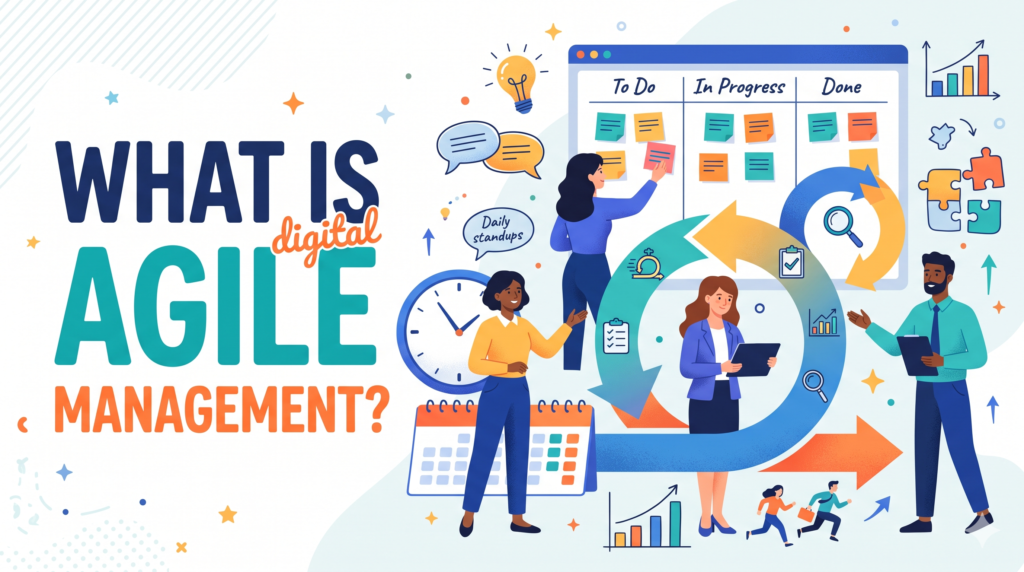
Kanban makes work visible on a board, physical or digital. The simplest board has three columns: to do, in progress and done. Cards move across as work advances, which makes bottlenecks and overloaded stages easy to see. Teams often cap how many items can be in progress at once so that work gets finished before more is started. Kanban suits ongoing work with steady incoming requests, such as support or content production.
Lean
Lean comes from manufacturing and focuses on removing waste, excess documentation, overproduction and fragmentation. Combined with agile, it is sometimes called lean agile, and it often uses value stream mapping to find where work is delayed or duplicated.
Extreme Programming, SAFe and Management-Level Approaches
Extreme Programming (XP) is mainly used in software and stresses short cycles, pair programming, test-driven development and frequent releases. SAFe helps large organisations coordinate many agile teams through shared planning and regular joint reviews. At the management level, Holacracy replaces fixed hierarchies with circles that hold defined roles and decision rights, while design thinking applies iterative, user-focused problem solving.
| Framework | Best for | Key practice |
|---|---|---|
| Scrum | Complex products with changing requirements | Fixed-length sprints with defined roles |
| Kanban | Continuous work with steady incoming requests | Visual board and limits on work in progress |
| Lean | Reducing waste in repeatable processes | Value stream mapping |
| XP | Software teams that need high technical quality | Pair programming and test-driven development |
| SAFe | Large organisations with many teams | Coordinated planning across teams |
Agile Management vs Waterfall
Waterfall is a sequential method in which every step is defined before work begins and each step must finish before the next one starts. It was described in depth in a 1970 paper by Winston Royce, who in fact criticised the pure sequential approach in that same paper.
Agile takes the opposite view. It assumes that the full lifecycle of a project cannot be known at the start, so it uses sprints and reviews to adjust along the way.
| Factor | Agile management | Waterfall |
|---|---|---|
| Planning | Goal set up front, detailed plans made in short horizons | Full plan made before work starts |
| Handling change | Expected and built in | Handled through formal change control |
| Customer involvement | Continuous, at every review | Mostly at the start and end |
| Delivery | Small usable increments | One final release |
| Documentation | Enough to support decisions and compliance | Extensive and written up front |
| Risk | Spotted early through frequent reviews | Often discovered late |
Neither approach is always better. Choose agile when requirements are likely to change after people see early results, when the work can be split into usable portions, when stakeholders can review regularly, and when the team has authority to re-prioritise. Waterfall can fit better when requirements and milestones are fixed in advance or external approvals limit how fast priorities can move. Many organisations use a hybrid, keeping fixed governance and milestone dates while allowing iterative delivery inside selected parts of the work.
Benefits of Agile Management
When it is used in the right conditions, agile management offers several advantages.
- Faster response to change. Short planning horizons let teams reconsider upcoming work before committing large amounts of time or budget.
- Earlier customer feedback. Stakeholders see real increments during delivery, which exposes misunderstandings before they affect the whole project.
- Better collaboration. Cross-functional teams and regular reviews break down silos and improve communication across departments.
- Visible progress. Usable increments show what has actually been completed, rather than relying only on status reports.
- Lower cost of changing direction. Priorities can be changed before substantial work has been built around an outdated assumption.
Agile works well for sales and customer-facing teams too. A sales team that reviews its pipeline in short cycles can spot weak points sooner, which is a practical route to improving sales performance. These gains are not automatic. They depend on stakeholders being available for reviews and on leaders being willing to act on what the feedback says.
Challenges and Common Mistakes
Agile management is not a quick fix, and it fails in predictable ways.
| Problem | Symptom | Fix |
|---|---|---|
| Culture mismatch | Staff wait to be told what to do, or managers keep approving every small decision | Train leaders first, and move decisions to the team step by step |
| Scope creep | The project quietly grows into something larger than intended | Assess every new request as essential or excessive at each review |
| Hard-to-forecast outcomes | Stakeholders cannot say when or at what cost the work will end | Fix a goal and a time box, and flex the scope inside them |
| Unclear decision rights | Teams stall because nobody knows who can approve a change | Write down who decides what, and review it each cycle |
| Agile theatre | Daily meetings and sprints happen, but nothing about decision-making has changed | Check whether feedback actually changes priorities, and if not, fix that before adding more ceremonies |
A further risk is constant reprioritisation. If every new request is treated as urgent, a team may switch direction so often that nothing is finished. Clear rules for prioritisation protect against this. Distributed teams add another layer of difficulty, since time zones and cultural differences make daily check-ins harder to schedule and can lead to misunderstandings.
Agile Management Beyond Software: Practical Examples
The following scenarios are illustrative. They show how the cycle of planning, delivering, reviewing and adjusting can look in different teams, and are not case studies with measured results.
A Marketing Team
A marketing team plans two-week cycles. In the first cycle it launches one landing page and one email, then reviews what visitors actually did. In the second, it keeps what worked and rewrites what did not. The goal stays fixed, but the activities change as evidence arrives. This is also how many people experience the daily reality of a marketing manager, who must balance planning with constant adjustment.
A Website Redesign
Rather than rebuilding every page and launching once, a team redesigns the homepage first and tests it with users. If visitors struggle to find key pages, the next cycle improves navigation and product pages. A third cycle adds comparison content and clearer calls to action. Our website redesign checklist is a useful companion for planning those stages.
Sales and Client Onboarding
A service business reviews its onboarding process every two weeks. In the first cycle, it removes one repeated manual step. In the next, it fixes the slowest hand-off between sales and delivery. Each small change is checked against real client feedback before the next one is chosen.
Operations in a Small Business
A small team lists its repetitive tasks and picks one to simplify each cycle. After a few cycles, hours saved are visible and the team knows where to go next. For ideas on where to begin, see our guide to small business automation.
How to Start With Agile Management: A Seven-Step Roadmap
You do not need to change the whole organisation at once. A single team and a single real problem are enough to begin.
- Set a clear goal. Define the outcome you want, such as shorter response times or more qualified leads. You do not need every requirement yet, only enough direction to decide what comes first.
- Pick one team and one real problem. Start small. Choose a team that is open to trying a new way of working and a problem that matters to the business.
- Choose a simple framework. Scrum suits work with defined cycles and roles. Kanban suits continuous work with steady incoming requests. Do not mix several at the start.
- Build a prioritised list of work. Break the goal into small items and order them by customer value, risk and dependencies. Keep the list visible to everyone.
- Run a two-week cycle. Hold a short daily check-in to surface blockers. Aim to finish a small, usable piece of work by the end of the cycle.
- Review and reflect. Show the finished work to stakeholders, collect feedback, and hold a short retrospective on how the team worked. Decide what to keep and what to change.
- Adjust, then expand. Use what you learned to reshape the list and the process. Once the first team has a steady rhythm, add a second team, keeping scope creep in check by assessing each new request against the goal.
Each step needs an owner. Without one, reviews get skipped and the approach quietly fades. If you want structured help mapping workflows and finding what to improve first, our digital consulting and process automation service is built for that kind of review, and our business automation package can help turn the fixes into working systems.
Agile Tools and Metrics
Most teams use some form of board, a backlog tool or a shared tracker to make work visible. For sales and client work, a CRM pipeline often plays the same role, and our comparison of the best CRMs for service-based small businesses is a good starting point. Choose the simplest tool that your team will actually update.
Three measures are more useful than most:
- Lead time: how long a request takes from first being raised to being finished.
- Cycle time: how long work takes once the team actually starts it.
- Work in progress: how many items are open at once. Lower numbers usually mean work gets finished faster.
Velocity, the amount of work a team completes in a cycle, can help with planning. It should not be used to rank people or teams, because that encourages gaming the numbers instead of delivering value.
Agile Management and AI
AI tools are now commonly used to draft backlog items, summarise customer feedback and flag repeated issues in support tickets. They can speed up the preparation work around each cycle. People still need to decide priorities and judge what is worth building. If you are exploring this direction, our article on agentic AI applications shows how a problem-first approach keeps the focus on real needs.
Frequently Asked Questions
What is agile management in simple terms?
Agile management is a flexible way of leading a team. Work is done in short cycles, feedback is gathered often, and plans are updated as the team learns. The goal is to deliver value sooner and adapt when needs change.
What is the difference between agile and Scrum?
Agile is a broad philosophy built on shared values and principles. Scrum is one specific framework that applies those ideas through sprints, defined roles and regular meetings. Teams can be agile without using Scrum.
What are the four agile values?
They are individuals and interactions over processes and tools, working software over comprehensive documentation, customer collaboration over contract negotiation, and responding to change over following a plan.
Is agile management only for software teams?
No. The Manifesto was written for software, but marketing, operations, HR, construction, manufacturing and government teams all apply agile ideas. The key requirement is that work can be delivered in small pieces and reviewed regularly.
Does agile mean there is no planning?
No. Agile teams still set goals, manage risk, budgets and deadlines. They plan in shorter horizons and expect to revise the plan, instead of fixing every detail at the start.
Can agile and waterfall be combined?
Yes. A hybrid approach can keep fixed governance, budgets and milestone dates while allowing iterative delivery within selected parts of the work. It suits projects with firm constraints and uncertain details.
Conclusion
Agile management is a way of leading that favours short cycles, honest feedback and steady adjustment over rigid long-term plans. It works best where requirements change, customers can review early results and teams are trusted to decide how to do the work. It is not a cure for every problem, and it needs real changes in how leaders make decisions, not just new meetings. The best way to begin is small: one team, one clear goal and one two-week cycle, followed by an honest review. If you would like help deciding where agile fits in your business, you can talk to our team about a practical starting point.