
What the Selected Inventory Costing Method Impacts (Quick Answer)
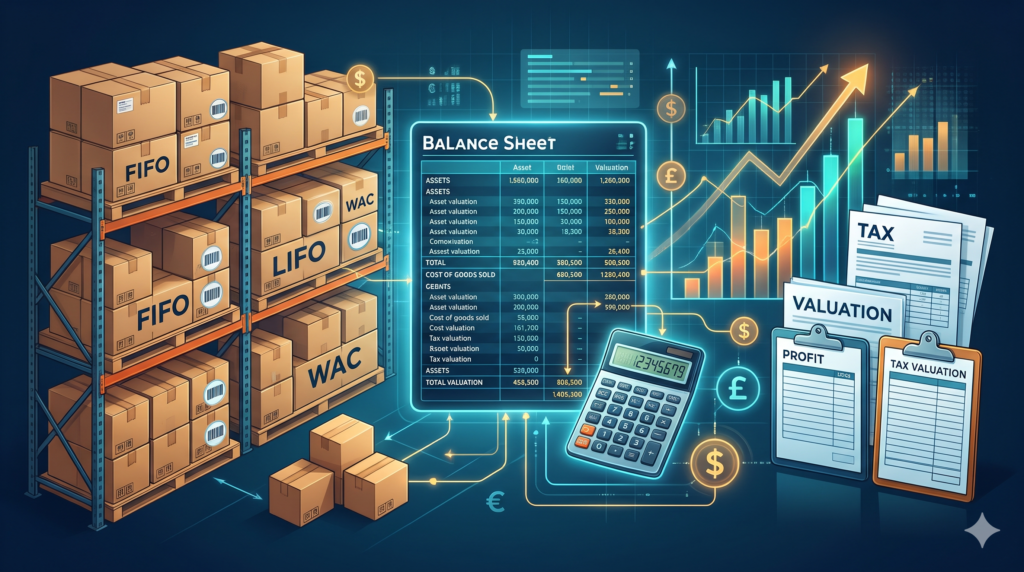
The selected inventory costing method impacts cost of goods sold, ending inventory, gross profit, net income, and income taxes. The reason is simple: purchase prices change over time, so the cost assigned to the units you sell depends on which costing method you use.
If a business paid exactly the same price for every unit, FIFO, LIFO, and weighted average would all produce identical numbers. Prices rarely stay still, so the method you pick changes what your financial statements say about the same goods. Pairing a costing method with sound inventory control practices keeps both your counts and your costs trustworthy.
| Area affected | What changes |
|---|---|
| Cost of goods sold (COGS) | The cost assigned to units sold |
| Ending inventory | The cost left on the balance sheet |
| Gross profit | Sales minus COGS |
| Net income | Profit after expenses and tax |
| Income taxes | Taxable income, and therefore tax owed |
This guide is educational and is not tax advice. Rules differ by country and change over time, so confirm specifics with a qualified professional.
Why the Costing Method Matters: Cost Flow vs Physical Flow
Inventory costing methods are cost flow assumptions. They decide which purchase costs are matched against sales first. They are accounting choices, not claims about which boxes physically leave the shelf first.
Physical movement can look quite different from the accounting treatment. Fresh milk is sold oldest first. Coal piled in a yard is often taken from the top, newest first. Fuel in a storage tank blends old and new together. Your physical flow of stock in your warehouse can follow one pattern while your books follow another, and that is acceptable. What matters is that the method you choose is allowed, fits your business, and is applied consistently.
The Four Inventory Costing Methods at a Glance
Four methods appear in nearly every accounting course and policy manual. Each one answers the same question differently: when you sell a unit that was bought at different prices over time, which cost goes to COGS?
Specific Identification
Specific identification assigns the actual cost of each individual unit to COGS when that exact unit is sold. It fits unique or serialized items such as vehicles, jewelry, or custom equipment. It is precise, but it can also let management influence margin by choosing which of several identical units to ship.
FIFO (First-In, First-Out)
FIFO assigns the oldest costs to COGS first. The newest costs stay in ending inventory. When purchase prices are rising, this gives lower COGS and a higher ending inventory value.
LIFO (Last-In, First-Out)
LIFO assigns the newest costs to COGS first. The oldest costs stay in ending inventory. When purchase prices are rising, this gives higher COGS and lower reported profit. LIFO is permitted under U.S. GAAP but not under IFRS.
Weighted Average Cost
Weighted average divides the total cost of goods available for sale by the total units available, then applies that single average to both COGS and ending inventory. Under a periodic system the average is calculated once for the period. Under a perpetual system a moving average is recalculated after each purchase, so results can differ slightly.
A related approach, the retail inventory method, estimates cost using a cost-to-retail ratio. It is used mainly by retailers and works best when markups are consistent.
| Method | How COGS is assigned | Best fit | Main limitation |
|---|---|---|---|
| Specific identification | Actual cost of the exact unit sold | Unique, high-value, or serialized goods | Labor intensive; allows margin influence |
| FIFO | Oldest costs first | Perishables and fast-moving goods | Higher taxable profit when prices rise |
| LIFO | Newest costs first | U.S. businesses facing sustained inflation | Not allowed under IFRS; outdated inventory values |
| Weighted average | Average cost of goods available | Interchangeable or mixed bulk items | Can hide cost trends |
Worked Example: Same Purchases, Three Different Results
The numbers below are hypothetical and are meant only to show the mechanics. Assume a periodic system, with the sale happening after all purchases are made.
- Beginning inventory: 100 units at $10
- Purchase 1: 100 units at $12
- Purchase 2: 100 units at $14
- Sales: 150 units at $30 each, so revenue is $4,500
- Operating expenses: $1,000
- Illustrative tax rate: 25%
Goods available for sale total 300 units costing $3,600 ($1,000 plus $1,200 plus $1,400).
How each method consumes the cost layers for the 150 units sold:
| Method | Layers charged to COGS | COGS |
|---|---|---|
| FIFO | 100 units at $10, then 50 units at $12 | $1,600 |
| LIFO | 100 units at $14, then 50 units at $12 | $2,000 |
| Weighted average | 150 units at $12 ($3,600 divided by 300) | $1,800 |
Results from the same goods and the same sales:
| Line item | FIFO | LIFO | Weighted average |
|---|---|---|---|
| Revenue | $4,500 | $4,500 | $4,500 |
| COGS | $1,600 | $2,000 | $1,800 |
| Gross profit | $2,900 | $2,500 | $2,700 |
| Operating expenses | $1,000 | $1,000 | $1,000 |
| Pre-tax income | $1,900 | $1,500 | $1,700 |
| Tax at 25% | $475 | $375 | $425 |
| Net income | $1,425 | $1,125 | $1,275 |
| Ending inventory | $2,000 | $1,600 | $1,800 |
Check: in every column, COGS plus ending inventory equals the $3,600 of goods available. Nothing was created or lost. The costs were simply divided differently between the income statement and the balance sheet.
The takeaway is that identical goods and identical sales produced a $400 spread in gross profit and a $100 spread in illustrative tax, purely from the costing method.
Impact on the Income Statement
Revenue does not change with the costing method. COGS does, and the rest of the income statement follows it. Gross profit equals sales minus COGS, so a higher COGS means a lower gross profit. Operating income and net income move in the same direction.
In the example, LIFO reports the highest COGS and the lowest profit, FIFO reports the lowest COGS and the highest profit, and weighted average lands between them. The customer paid the same $4,500 in every case. Only the reported profit changed.
Impact on the Balance Sheet
Ending inventory is the mirror image of COGS. Costs that are not charged to COGS remain on the balance sheet as inventory.
Under FIFO in a rising price environment, ending inventory is made up of the newest costs and sits close to current replacement cost. Under LIFO, ending inventory holds the oldest costs. If old layers have been carried for years, reported inventory can be a fraction of what it would cost to replace today.
Because inventory is usually a current asset, the method also affects total current assets, working capital, and the current ratio. Lenders and investors often look at these figures, so a lower reported inventory value can matter beyond the accounting itself.
Impact on Taxes and Cash Flow
Taxes follow taxable income. When prices rise, a method that charges higher costs to COGS lowers taxable income, and therefore tax owed in that year. That is why LIFO is associated with lower current taxes in an inflationary period, and FIFO with higher reported profit and higher taxes. When prices fall, the pattern reverses.
Two points are worth stating precisely:
- The method changes tax cash, not customer cash. The money collected from customers is the same under every method. What differs is the tax bill and the profit you report.
- U.S. LIFO conformity rule. A company that uses LIFO for federal tax purposes must also use LIFO in its financial statements. This stops a business from claiming low taxable profit with LIFO while showing investors higher profit under FIFO. A LIFO election is made through an IRS filing with the tax return, so confirm the current requirements with a tax professional.
Rules in other countries differ, and tax law changes, so treat the above as general background and not as advice for your situation.
Rising, Falling, and Stable Prices: How the Results Flip
The ranking of methods depends on the direction of purchase prices.
| Price trend | Highest COGS and lowest profit | Lowest COGS and highest profit | Weighted average |
|---|---|---|---|
| Rising | LIFO | FIFO | In between |
| Falling | FIFO | LIFO | In between |
| Stable | All methods produce the same results | All methods produce the same results | Same |
Weighted average smooths volatility because it blends old and new costs into one figure. That makes results steadier from period to period, though it can also blur real cost trends that matter for pricing decisions.
Impact on Financial Ratios and Comparability
Changing COGS and inventory changes ratios that analysts use to judge a business:
- Gross margin: moves directly with COGS.
- Inventory turnover (COGS divided by average inventory): under rising prices, LIFO shows a higher figure because COGS is higher and inventory is lower.
- Days sales of inventory: moves in the opposite direction to turnover.
- Current ratio: can be lower under LIFO because reported inventory is lower.
A LIFO company may look as though it turns inventory faster than a FIFO competitor without actually managing stock better. That is why analysts use the LIFO reserve, which is the difference between inventory valued under FIFO and inventory valued under LIFO. Companies using LIFO disclose it, which lets analysts convert figures and compare like with like.
GAAP, IFRS, and Where Each Method Is Allowed
| Standard | Methods permitted |
|---|---|
| U.S. GAAP | FIFO, LIFO, weighted average, and specific identification |
| IFRS (IAS 2) | FIFO, weighted average, and specific identification; LIFO is prohibited |
Companies must disclose which costing method they use in their financial statements. A U.S. business that expects to expand internationally, or to be acquired by a company that reports under IFRS, should weigh the fact that a switch away from LIFO may be needed later.
Risks and Pitfalls: Liquidation, Timing, and Errors
- LIFO liquidation: if you sell more than you buy, you reach into old, low-cost layers. COGS drops, profit jumps, and taxable income rises even though nothing improved economically.
- Year-end purchase timing: under LIFO, buying extra goods at high prices near period end pushes high costs into COGS and lowers income. Weighted average is affected to a lesser degree. FIFO is not affected by period-end purchases.
- Choosing which unit to ship: under specific identification, identical items bought at different prices let management influence the margin on a sale.
- Counting errors: an overstated ending inventory understates COGS and overstates profit in that period, and the error reverses in the next period.
How to Choose the Right Inventory Costing Method
There is no single correct method. Weigh these factors together:
- Industry and product type: perishable, interchangeable, or unique.
- Price trend: rising, falling, or stable purchase costs.
- Tax goals: and whether lower current tax is worth lower reported profit.
- Lender and investor expectations: how they read inventory and margin.
- International plans: whether IFRS may apply in the future.
- System capability: whether your software can track the method accurately.
| Business type | Often a good fit | Why |
|---|---|---|
| Perishable retail or food | FIFO | Matches the physical flow and tracks current cost |
| Commodity distributor (U.S. only) | LIFO or weighted average | LIFO can lower taxes under sustained inflation; average is simpler |
| Custom or high-value goods | Specific identification | Each unit has its own traceable cost |
| Multi-channel ecommerce | Weighted average or FIFO | One cost per SKU simplifies tracking across channels |
Whatever you choose, your accounting must be able to support it. A modern ERP system can maintain cost layers automatically, and a solid accounting integration ensures those costs flow into your books without manual re-entry.
Can You Change Your Inventory Costing Method?
The consistency principle says a business should use the same method from period to period so that statements stay comparable. A change needs a valid reason, disclosure, and restating of the periods presented. For tax purposes, changing a method generally requires approval from the tax authority, so speak with a tax professional before switching. Changing methods repeatedly to report higher income runs against the principle of consistency.
Keeping Cost Layers Accurate With Software and Automation
FIFO and LIFO depend on tracking each purchase layer by date, quantity, and unit cost. Doing that in spreadsheets invites errors that compound every month. A perpetual system records cost layers on every receipt and sale, so COGS and ending inventory stay current.
Areas worth automating:
- Recording receipts with landed cost, including freight and duties
- Selecting the correct cost layer on each sale
- Syncing orders, stock levels, and accounting entries
Sellers who run several sales channels benefit most from ecommerce integration that keeps orders, stock, and accounting aligned. More broadly, business process automation removes repetitive cost tracking so your team can focus on analysis.
Frequently Asked Questions
What does the selected inventory costing method impact?
It impacts cost of goods sold, ending inventory, gross profit, net income, and income taxes. These all move because the method decides which purchase costs are charged to sales and which remain in inventory.
Which method gives the highest net income when prices rise?
FIFO. It charges the oldest and cheapest costs to COGS, so COGS is lowest and reported profit is highest. LIFO gives the lowest, and weighted average falls in between.
Which method gives the lowest taxes when prices rise?
LIFO generally gives the lowest taxable income and lowest current tax during rising prices, because it charges the newest and highest costs to COGS. In the United States, LIFO for tax requires LIFO in the financial statements as well.
Is LIFO allowed under IFRS?
No. IAS 2 prohibits LIFO. FIFO and weighted average are accepted under IFRS, and LIFO is permitted under U.S. GAAP.
Does the costing method change cash flow?
It does not change the cash collected from customers. It can change cash paid for income taxes, because taxable income differs by method.
How do retailers handle inventory costing during heavy promotions?
Discounts lower selling prices, not the purchase cost of the units, so the chosen method still assigns costs the same way. What changes is volume and margin, and overstocking after a promotion can tie up cash and distort inventory figures. See our guide to retail promotions and inventory management for ways to avoid overload.
Conclusion and Next Step
The selected inventory costing method impacts cost of goods sold, ending inventory, gross profit, net income, and taxes. The same goods can tell a different financial story depending on whether you use FIFO, LIFO, weighted average, or specific identification. The best choice depends on your products, price trends, tax position, and plans for growth, and it should be applied consistently once chosen.
If you want accurate cost tracking without manual spreadsheets, talk to our team about automating your inventory workflows.