
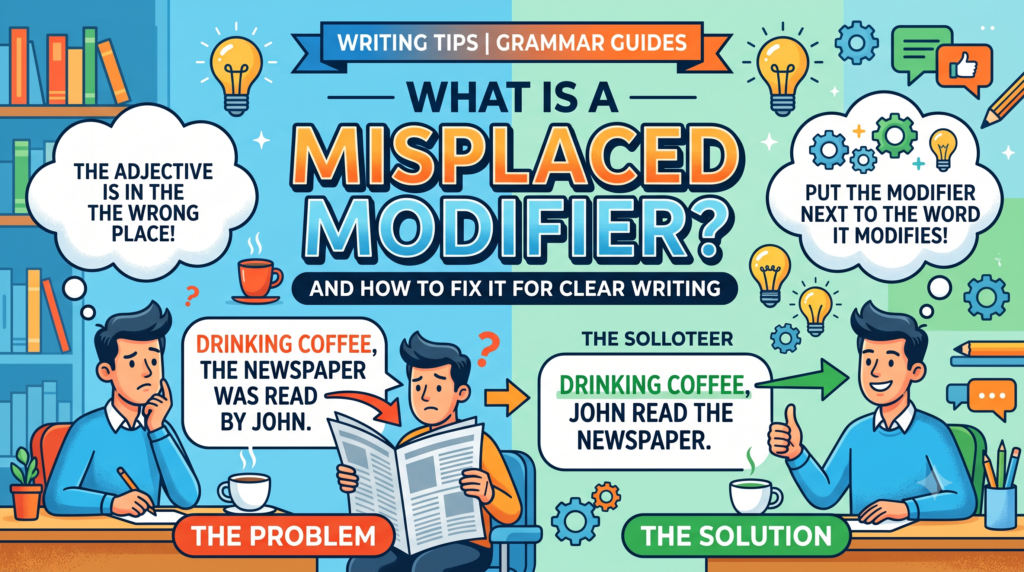
What Is a Misplaced Modifier? Definition, Types, Examples and Fixes
Read this sentence out loud: “The manager fired the assistant with a loud voice.” Who has the loud voice? The sentence says the assistant does, but the writer almost certainly meant the manager. That small slip is a misplaced modifier, and it is one of the most common grammar errors in professional, academic, and marketing writing.
If you have ever reread a sentence and felt that something was off without knowing why, a misplaced modifier is often the cause. The words are all correct, but one of them is describing the wrong thing. This guide explains what a misplaced modifier is, shows you every major type with clear misplaced modifier examples, and gives you a repeatable method to fix them. You will also learn how misplaced modifiers differ from dangling and squinting modifiers, and how to catch them before your readers do.
What Is a Misplaced Modifier?
A misplaced modifier is a word, phrase, or clause that sits too far from the word it is meant to describe, so the sentence seems to describe something else. Because readers connect a modifier to the nearest sensible word, a misplaced modifier pulls their attention to the wrong target. The result is a sentence that is confusing, awkward, or accidentally funny.
Here is a simple example:
- Incorrect: She served sandwiches to the guests on paper plates.
- Correct: She served sandwiches on paper plates to the guests.
In the first version, the phrase “on paper plates” sits next to “guests,” which suggests the guests are on paper plates. In the second version, the phrase sits next to “sandwiches,” which is what it actually describes.
The key idea is that a misplaced modifier always has a correct target somewhere in the sentence. The writer simply put the modifier in the wrong spot. That is what separates it from a dangling modifier, which has no logical target at all. We will compare the two later in this guide.
What Is a Modifier in a Sentence?
To understand a misplaced modifier, you first need to understand modifiers themselves. A modifier is any word or group of words that adds detail to another part of a sentence. Modifiers describe, limit, or clarify nouns, verbs, and other modifiers. They make sentences specific, but they only work when the reader can tell what they belong to.
Modifiers come in four common forms:
- Adjectives describe nouns: a tall building, the red folder.
- Adverbs describe verbs, adjectives, or other adverbs: she spoke quietly, an extremely useful tool.
- Phrases are groups of words without a full subject and verb: in the morning, running down the street, to finish the report.
- Clauses contain a subject and a verb and add extra detail: that was too large, which arrived late.
The central rule of modifier placement is simple: put the modifier as close as possible to the word it describes. Single-word modifiers usually sit right before the word they describe. Longer phrases and clauses usually sit right before or right after it. When you follow that rule, your meaning stays clear. When you break it, you get a misplaced modifier.
Why Misplaced Modifiers Matter
Misplaced modifiers might seem like a small issue, but they affect how readers understand and trust your writing.
They change your meaning. A misplaced modifier can make a sentence say something you never intended. In an email, a contract summary, or a product description, that can cause real confusion.
They slow readers down. Readers stop to untangle the sentence. Every pause increases the chance they will skim, misunderstand, or leave.
They reduce credibility. Grammar errors signal carelessness. A business that publishes sentences with unclear modifiers can look less professional, even if its product or service is excellent.
They hurt content quality. Clear sentences are a basic part of useful web content. If you are running a content audit on an existing website, sentence-level clarity is one of the easiest things to review and improve. Pages that read well tend to hold attention longer, and that supports any broader SEO content strategy you build around them.
Marketers, in particular, write constantly: ads, landing pages, emails, social posts. Anyone in a role like the one described in this guide to what a marketing manager does benefits from knowing how to keep modifiers where they belong.
Types of Misplaced Modifiers
Misplaced modifiers show up in several forms. Learning each type makes them far easier to spot.
Misplaced Adjectives
An adjective that is separated from its noun can attach itself to the wrong word.
- Incorrect: The chef served a bowl of soup to the customer that was cold.
- Correct: The chef served a bowl of soup that was cold to the customer.
Here the adjective clause “that was cold” should describe the soup, not the customer. Moving it right after “soup” fixes the problem.
Misplaced Adverbs and Limiting Modifiers
Adverbs are the most frequently misplaced modifiers in everyday speech. A special group called limiting modifiers causes the most trouble. These include words like only, almost, just, even, nearly, merely, and simply. A limiting modifier should sit directly before the word it limits.
Notice how moving the word only changes the meaning of this sentence:
- Only the manager approved the budget. (No one else approved it.)
- The manager only approved the budget. (The manager did nothing else with it.)
- The manager approved only the budget. (Nothing else was approved.)
- The manager approved the only budget. (There was one budget.)
The words in the sentence did not change, but the meaning did. This is why limiting modifiers deserve extra attention.
Another common case involves the word almost:
- Incorrect: The team almost finished every task.
- Correct: The team finished almost every task.
The first version suggests the team came close to finishing every task but may have finished none. The second says they completed nearly all of them.
Misplaced Prepositional Phrases
A prepositional phrase begins with a word like in, on, with, for, or from. When it floats away from its target, the sentence can become unintentionally strange.
- Incorrect: I saw a woman walking down the street with a broken umbrella.
- Correct: I saw a woman with a broken umbrella walking down the street.
The first version could mean the street has a broken umbrella, or that the person walking is carrying one in an odd way. The second version leaves no doubt.
Misplaced Participial Phrases
A participial phrase uses an -ing or -ed verb form to describe a noun. These phrases need to sit next to the noun they describe.
- Incorrect: The dog barked at the mail carrier wagging its tail.
- Correct: Wagging its tail, the dog barked at the mail carrier.
In the first sentence, it sounds like the mail carrier is wagging a tail. Moving the phrase to the front ties it to the dog.
Misplaced Adjective Clauses
Clauses that begin with words like who, which, or that are called relative or adjective clauses. They should follow the noun they describe as closely as possible.
- Incorrect: We rented a cabin from the owner that had a fireplace.
- Correct: We rented a cabin that had a fireplace from the owner.
Without the correction, it sounds like the owner has a fireplace.
Misplaced Modifier vs. Dangling Modifier vs. Squinting Modifier
Writers often mix up three related errors. They all involve unclear modification, but they have different causes and different fixes.
| Error type | What goes wrong | How to fix it |
|---|---|---|
| Misplaced modifier | The modifier is in the wrong position, but its target is in the sentence | Move the modifier next to its target |
| Dangling modifier | The sentence has no word for the modifier to describe | Add the missing subject or rewrite the sentence |
| Squinting modifier | The modifier could describe the word before it or the word after it | Move or reword so only one reading is possible |
Dangling Modifier
A dangling modifier has nothing logical to attach to. The target is not missing from its position, it is missing from the sentence.
- Incorrect: After reading the report, the meeting was rescheduled.
- Correct: After reading the report, the director rescheduled the meeting.
Moving the phrase will not help in the first sentence, because there is no person in the sentence who did the reading. You have to add the missing subject.
Squinting Modifier
A squinting modifier sits between two words and could describe either one.
- Unclear: Employees who exercise regularly feel more energetic.
- Clearer: Employees who regularly exercise feel more energetic. Or: Regularly, employees who exercise feel more energetic.
Does “regularly” describe how often they exercise, or how often they feel energetic? When the sentence leaves that open, the modifier is squinting. The fix is to reposition it so only one meaning remains.
A quick way to remember the difference: with a misplaced modifier, the target exists but is too far away. With a dangling modifier, the target does not exist. With a squinting modifier, the target could be one of two things.
How to Fix a Misplaced Modifier: A Step-by-Step Method
Fixing a misplaced modifier takes only a few minutes once you know the process. Use these steps whenever a sentence feels unclear.
- Find the modifier. Look for the word, phrase, or clause that adds detail. Ask yourself what extra information is being given.
- Identify what it should describe. Decide which noun, verb, or idea the modifier is supposed to be attached to. This is your intended target.
- Check the distance. If the modifier is not right next to that target, you have found the problem.
- Move the modifier. Place it immediately before or after its target, depending on the type of modifier. Single words usually go before. Phrases and clauses can go before or after.
- Reread for new problems. After moving the modifier, make sure it does not now attach to a different word by accident. A fix that creates a second possible meaning is not a fix.
- Rewrite if needed. Sometimes the cleanest solution is a small rewrite, such as splitting a long sentence in two.
Here is the method applied to one sentence:
- Original: The consultant presented a plan to the executives that would reduce costs.
- Step 1: The modifier is “that would reduce costs.”
- Step 2: It should describe the plan, not the executives.
- Step 3: It is next to “executives,” which is the wrong word.
- Step 4: Move it next to “plan.”
- Result: The consultant presented a plan that would reduce costs to the executives.
For very long sentences, a rewrite can sound more natural: “The consultant presented the executives with a plan that would reduce costs.”
More Misplaced Modifier Examples With Corrections
Seeing many examples builds your instincts. Here are common patterns, each with a correction.
Example 1: Limiting modifier
- Incorrect: I only have two hours to finish this draft.
- Better: I have only two hours to finish this draft.
The corrected version places “only” next to the amount it limits.
Example 2: Prepositional phrase
- Incorrect: The report was handed to the client in a leather folder.
- Better: The report in a leather folder was handed to the client.
Example 3: Participial phrase
- Incorrect: Covered in frosting, Maria handed me the cake.
- Better: Maria handed me the cake, which was covered in frosting.
Example 4: Adjective clause
- Incorrect: He returned the laptop to the store that had a cracked screen.
- Better: He returned the laptop that had a cracked screen to the store.
Example 5: Business writing
- Incorrect: Our team offers support for customers who need help around the clock.
- Better: Our team offers around-the-clock support for customers who need help.
Example 6: Marketing copy
- Incorrect: Get a free quote on our services by calling today.
- Better: Call today to get a free quote on our services.
Notice that in marketing copy especially, a misplaced modifier can weaken a call to action. If you want your offers to land cleanly, clarity matters as much as persuasion.
Where Misplaced Modifiers Hide in Everyday Writing
Misplaced modifiers rarely announce themselves. They tend to appear in specific situations.
Long sentences. The more words between a modifier and its target, the more likely the two will drift apart. If a sentence runs beyond two lines, check every modifier in it.
Sentences with several nouns. When a sentence contains multiple people or objects, a modifier has many chances to attach to the wrong one.
Fast drafting. Writers often add details after the first draft is finished. Squeezing a new phrase into an existing sentence is a common way to create a misplaced modifier.
Website and marketing copy. Headlines, meta descriptions, button text, and ad copy are short, which makes errors more visible. A clear website title and clean page copy work together to show visitors and search engines what a page is about. When you make a website, reviewing sentences for modifier placement is a small step that improves the whole experience.
Link text and calls to action. Even the words around a link need clear modification. The way you phrase the sentence around an anchor affects how clearly it reads, which is one reason people studying hyperlinks in SEO pay attention to the surrounding words, not just the link itself.
Email. Fast-written messages are full of loose modifiers. Teams that run email marketing services know that one unclear subject line or opening sentence can change how a message is understood.
How to Spot Misplaced Modifiers in Your Own Writing
Catching your own errors is harder than catching someone else’s, because your brain fills in what you meant. These habits help.
Read aloud. Awkward or unintentionally funny sentences are easier to hear than to see. When you hit a stumble, look for a modifier.
Ask “what does this describe?” For every phrase and clause, name its target. If the target is not the closest noun, you have a problem.
Check limiting words. Search your draft for only, almost, just, even, and nearly. Confirm each one sits right before the word it should limit.
Look at the end of the sentence. Phrases piled onto the end of a sentence are a common source of errors, because writers add them as afterthoughts.
Take a break before editing. Fresh eyes notice what tired eyes skip.
Use tools, but do not trust them blindly. Grammar checkers catch some misplaced modifiers, but they miss many, especially subtle ones with limiting words. Your own review is still essential.
Edit for one thing at a time. Do one pass only for modifiers. Focused reading finds more errors than a general proofread.
If you manage a site with a lot of pages, a systematic review is more practical than hoping you notice errors by chance. Professional SEO services often include content review, and for sites built on that platform, strong WordPress SEO optimization pairs technical improvements with clear, well-edited copy.
Practice: Fix These Misplaced Modifiers
Try correcting these sentences before checking the suggested answers.
- The waiter brought a salad to the table with extra dressing.
- We nearly waited an hour for the train.
- The professor handed back the essays to the students that were graded.
- Running through the park, the fountain caught her eye.
- The company sells products to customers online that are eco-friendly.
Suggested answers:
- The waiter brought a salad with extra dressing to the table.
- We waited nearly an hour for the train.
- The professor handed back the essays that were graded to the students. (Or: The professor handed the students their graded essays.)
- Number 4 is actually a dangling modifier, not a misplaced one. Rewrite it with a subject: Running through the park, she noticed the fountain.
- The company sells eco-friendly products to customers online.
Notice that sentence 4 trips people up. Moving the phrase would not solve it, because the sentence has no one for “running” to describe. This is exactly why knowing the difference between the error types matters.
Frequently Asked Questions About Misplaced Modifiers
What is a misplaced modifier in simple terms?
A misplaced modifier is a describing word or phrase that sits in the wrong spot, so it seems to describe something other than what you meant. Moving it next to the right word fixes the problem.
What is the difference between a misplaced modifier and a dangling modifier?
With a misplaced modifier, the word being described is in the sentence but sits too far away. With a dangling modifier, the word being described is missing entirely. Misplaced modifiers are fixed by moving them. Dangling modifiers are fixed by adding the missing subject.
How do you fix a misplaced modifier?
Identify the modifier, work out what it should describe, and move it directly next to that word. Then reread the sentence to make sure the new position does not create a different confusion.
Can a single word be a misplaced modifier?
Yes. Single words, especially limiting modifiers like only, almost, and just, are among the most commonly misplaced modifiers. Moving one word can completely change what a sentence means.
Are misplaced modifiers always wrong?
In formal writing, yes, they are treated as errors. In casual speech, people often place modifiers loosely and listeners understand from context. Still, writing does not have tone of voice or facial expression to help, so it is safer to place modifiers carefully.
Why do misplaced modifiers matter in marketing and web content?
Marketing copy is short and persuasive, so unclear wording can weaken the message or create unintended meanings. Clear sentences help readers understand your offer quickly and trust your brand.
Key Takeaways
- A misplaced modifier is a word, phrase, or clause positioned so far from its target that it appears to describe something else.
- Common types include misplaced adjectives, adverbs, limiting modifiers, prepositional phrases, participial phrases, and adjective clauses.
- Misplaced modifiers differ from dangling modifiers, which have no target, and squinting modifiers, which could describe two targets.
- The fix is almost always to move the modifier directly next to the word it describes, then reread to confirm the meaning is clear.
- Limiting words such as only and almost deserve special attention because small position changes alter meaning.
- Reading aloud, naming each modifier’s target, and doing a dedicated modifier pass are the most reliable ways to catch errors.
Final Thoughts
A misplaced modifier is a small mistake with a big effect on clarity. Once you understand that every modifier needs to sit beside the word it describes, the rest becomes a matter of habit. Check your longer sentences, watch your limiting words, and always ask what each phrase is really describing.
Clear writing is a skill that pays off in every part of your business, from website copy to emails to sales pages. If you want a team that helps with web content, design, and search visibility, you can contact The Cloud Republic to talk through your goals.