
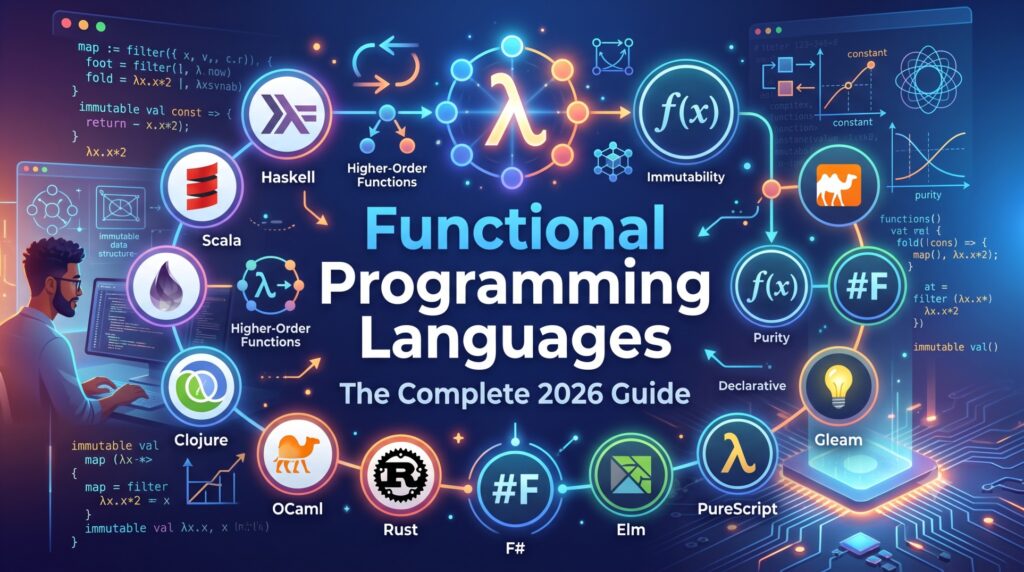
Functional Programming Languages: The Complete 2026 Guide
Functional programming languages have moved from academic curiosity to mainstream engineering practice. As software systems grow more concurrent, more distributed, and more data heavy, the principles behind functional programming languages, immutability, pure functions, and declarative logic, solve problems that traditional imperative code often struggles with. This guide breaks down what functional programming languages are, why they matter in 2026, the top languages worth learning, and how businesses can use functional thinking to build faster, more reliable software.
Whether you are a developer choosing your next language, a technical lead planning an architecture, or a business owner trying to understand why your engineering team keeps mentioning immutability, this guide covers everything you need.
What Are Functional Programming Languages
Functional programming languages are languages built around the idea of computation as the evaluation of mathematical functions, rather than a sequence of changing program states. Instead of writing step by step instructions that mutate variables, developers write functions that take inputs and return outputs without side effects.
Core characteristics of functional programming languages include:
- Pure functions: given the same input, a pure function always returns the same output and does not alter anything outside its own scope.
- Immutability: data structures are not changed after creation. New values are produced instead of modifying existing ones.
- First class and higher order functions: functions can be passed as arguments, returned from other functions, and stored in variables like any other data type.
- Declarative style: code describes what should happen rather than how to do it step by step.
- Recursion over loops: many functional programming languages favor recursion as the primary looping mechanism.
- Lazy evaluation: some functional programming languages delay computation until the result is actually needed, which can improve performance and enable infinite data structures.
These traits are not exclusive to purely functional languages. Many modern general purpose languages, including Python, JavaScript, and Java, have borrowed functional features, but a handful of languages are built functional first, and those are the focus of this guide.
Why Functional Programming Languages Matter in 2026
Functional programming is not new. Its roots trace back to Lisp in the late 1950s and the lambda calculus decades before that. What has changed is the environment software runs in.
Concurrency and Parallelism
Modern applications run across multiple cores, multiple servers, and multiple regions. Shared mutable state is one of the hardest problems in concurrent programming because two threads changing the same variable at the same time can cause bugs that are difficult to reproduce. Functional programming languages avoid this problem by design, since immutable data cannot be corrupted by simultaneous access. This is a major reason languages like Erlang and Elixir dominate telecom and messaging infrastructure, and why Rust borrowed heavily from functional principles for its ownership model.
Data Science and Machine Learning
Data pipelines are naturally functional. A pipeline takes raw data, transforms it through a series of steps, and produces an output, without needing to track changing state along the way. This maps directly onto function composition, one of the foundational ideas in functional programming languages. Tools like Apache Spark expose functional style APIs for exactly this reason.
Reliability at Scale
Systems that cannot afford downtime, financial trading platforms, telecom switches, blockchain infrastructure, increasingly rely on the predictability that comes from pure functions and immutable state. When a function cannot produce side effects, it becomes far easier to test, reason about, and prove correct.
The Rise of Type Safe, Functional First Tooling
Static type systems paired with functional principles catch entire categories of bugs before code ever runs. Languages like Haskell, OCaml, and F# use type systems that make illegal states unrepresentable, meaning many runtime errors simply cannot occur if the code compiles.
A Brief History of Functional Programming Languages
Understanding where functional programming languages came from helps explain why they are built the way they are. The theoretical foundation goes back to Alonzo Church’s lambda calculus in the 1930s, a mathematical system for expressing computation purely through function abstraction and application. This was decades before electronic computers existed, yet it laid the groundwork for everything that followed.
Lisp arrived in 1958, created by John McCarthy, and became the first practical implementation of many functional ideas, including recursion, higher order functions, and the treatment of code as data. Over the following decades, ML introduced static typing to the functional world in the 1970s, and Haskell arrived in 1990 as an attempt to unify the many competing lazy functional languages of the time into a single, rigorously designed standard.
Erlang, developed at Ericsson in the mid 1980s, took functional programming in a different direction entirely, focusing on concurrency and fault tolerance for telecom hardware rather than academic purity. That lineage eventually produced Elixir in 2012, which modernized Erlang’s runtime with a friendlier syntax.
More recently, mainstream languages have absorbed functional ideas piece by piece. Java added lambda expressions and streams in 2014. C++ added lambdas in C++11. JavaScript’s entire ecosystem of functional libraries grew alongside the language’s native support for first class functions. Rust, first stabilized in 2015, built an entire memory safety model on ideas borrowed from functional type systems. This steady mainstream adoption is the clearest signal that functional programming languages are not a passing trend, they are a permanent part of how modern software gets built.
Functional Programming vs Object Oriented vs Imperative Programming
To fully appreciate what functional programming languages offer, it helps to compare them directly against the two other dominant paradigms.
Imperative programming describes computation as a sequence of statements that change program state step by step, using loops, variable assignment, and explicit control flow. It maps closely to how hardware actually executes instructions, which is why it was the dominant early paradigm, but it also makes state changes and side effects harder to track as programs grow.
Object oriented programming organizes code around objects that bundle data and behavior together, using concepts like inheritance, encapsulation, and polymorphism. It excels at modeling real world entities and managing large codebases through clear boundaries, but mutable shared state between objects can still introduce the same concurrency problems that plague imperative code.
Functional programming avoids mutable state almost entirely, favoring pure functions and immutable data. This makes reasoning about individual pieces of a program easier in isolation, since a function’s behavior depends only on its inputs, not on some external state that might have changed elsewhere. The tradeoff is that functional programming languages sometimes require a different mental model for representing things that naturally change over time, like a running total or a user session.
In practice, most production systems in 2026 are not purely one paradigm. A typical backend might use object oriented structure for its overall architecture, imperative code for low level performance critical loops, and functional patterns for data transformation pipelines and business logic. Understanding functional programming languages gives developers another tool to reach for, not a replacement for everything else they know.
Key Concepts Every Functional Programming Language Shares
Before diving into individual languages, it helps to understand the vocabulary that shows up across nearly all functional programming languages.
- Referential transparency: an expression can be replaced with its resulting value without changing the program’s behavior, which is only possible when functions are pure.
- Function composition: building complex behavior by chaining together small, simple functions, where the output of one becomes the input of the next.
- Pattern matching: a control flow mechanism that lets code branch based on the shape or structure of data, often replacing long chains of conditional statements.
- Algebraic data types: a way of defining data structures that can be one of several distinct shapes, commonly used to model things like optional values or results that can succeed or fail.
- Currying and partial application: transforming a function that takes multiple arguments into a series of functions that each take one argument, enabling flexible reuse.
- Tail call optimization: a compiler technique that allows certain recursive functions to run in constant memory, which is essential since functional programming languages rely heavily on recursion instead of loops.
These concepts recur throughout every language covered in this guide, and recognizing them will make switching between functional programming languages significantly easier once you have learned one well.
Top Functional Programming Languages to Know in 2026
Below is a breakdown of the functional programming languages most worth learning right now, grouped by where they excel.
1. Haskell
Haskell is the closest thing to a pure functional programming language in widespread use. Every function in Haskell is pure by default, and side effects like input and output are handled through a construct called a monad, which keeps effectful code clearly separated from pure logic.
Strengths: an extremely expressive type system, strong academic and financial industry adoption, and a design that forces disciplined code.
Best for: teams that want maximum correctness guarantees, compiler research, financial modeling, and developers who want to deeply understand functional theory.
Learning curve: steep. Concepts like monads and type classes take time to internalize, but the payoff in code reliability is significant.
2. Elixir
Built on the Erlang virtual machine, Elixir combines a modern, approachable syntax with the fault tolerant, highly concurrent runtime that made Erlang famous. Elixir powers the Phoenix web framework, which is known for handling massive numbers of simultaneous connections with low latency.
Strengths: excellent concurrency model, “let it crash” fault tolerance philosophy, friendly syntax compared to Erlang, and a growing web development ecosystem.
Best for: real time applications, chat systems, IoT platforms, and teams that want functional benefits without a steep academic learning curve.
3. Erlang
Erlang was built by Ericsson in the 1980s to run telecom switches that needed to stay online for years at a time. Its actor based concurrency model, where lightweight processes communicate only through message passing, has influenced nearly every modern concurrent system design.
Strengths: proven reliability, hot code swapping without downtime, and a battle tested runtime.
Best for: telecom systems, messaging platforms, and any application where uptime is non negotiable.
4. Clojure
Clojure is a modern Lisp dialect that runs on the Java Virtual Machine, giving it access to the massive Java ecosystem while embracing functional programming and immutable data structures at its core. Clojure emphasizes simplicity and data oriented design over complex abstractions.
Strengths: seamless interop with Java libraries, powerful immutable data structures, and a strong REPL driven development workflow.
Best for: teams already invested in the JVM ecosystem who want functional benefits, and developers who value interactive, exploratory coding.
5. F#
F# is Microsoft’s functional first language on the .NET platform. It offers a concise, type safe syntax and full interoperability with C# and the wider .NET ecosystem, making it a practical entry point for teams already using Microsoft technologies.
Strengths: strong type inference, first class support in Visual Studio, and full access to .NET libraries.
Best for: .NET shops that want functional programming benefits without abandoning their existing toolchain.
6. Scala
Scala blends object oriented and functional programming on the JVM. It is the language behind Apache Spark, and it is widely used in data engineering and backend systems that need both functional rigor and the flexibility of object orientation.
Strengths: powerful type system, seamless Java interop, and dominance in big data tooling through Spark.
Best for: data engineering teams, backend systems needing high throughput, and organizations transitioning from Java.
7. OCaml
OCaml is a statically typed functional language known for combining performance close to C with a strong, expressive type system. It has found a home in compiler design, financial systems, and formal verification tools.
Strengths: fast compiled performance, a sophisticated module system, and strong tooling for building other languages and compilers.
Best for: systems programming that needs both safety and speed, financial trading systems, and language tooling.
8. Rust
Rust is not a purely functional programming language, but it borrows heavily from functional principles, immutability by default, pattern matching, algebraic data types, and an emphasis on eliminating entire classes of bugs at compile time. Its ownership model was directly inspired by ideas from the functional programming world.
Strengths: memory safety without a garbage collector, blazing performance, and a growing systems programming community.
Best for: performance critical systems, WebAssembly, and teams that want functional discipline in a systems language.
9. Lisp and Scheme
The original functional programming languages, Lisp and its descendant Scheme, remain influential in computer science education and specialized domains like artificial intelligence research and language design. Their minimalist syntax, built almost entirely from parentheses and symbolic expressions, makes code and data structurally identical, a property called homoiconicity.
Strengths: conceptual simplicity, powerful macro systems, and unmatched flexibility for building domain specific languages.
Best for: language research, education, and highly customizable systems.
10. Python and JavaScript, the Functional Adjacent Languages
While not purely functional programming languages, Python and JavaScript both support functional style programming through first class functions, list comprehensions, map and filter operations, and libraries built specifically for functional patterns. Many teams get meaningful benefits from applying functional programming principles inside these mainstream languages without switching ecosystems entirely.
Functional Programming Languages Comparison Table
| Language | Paradigm Style | Typing | Best Use Case | Learning Curve |
|---|---|---|---|---|
| Haskell | Purely functional | Static, strong | Correctness critical systems | Steep |
| Elixir | Functional, concurrent | Dynamic | Real time, fault tolerant apps | Moderate |
| Erlang | Functional, concurrent | Dynamic | Telecom, messaging | Moderate |
| Clojure | Functional Lisp | Dynamic | JVM based data systems | Moderate |
| F# | Functional first | Static, strong | .NET ecosystem projects | Moderate |
| Scala | Functional and OOP | Static, strong | Big data, backend systems | Moderate to steep |
| OCaml | Functional, static | Static, strong | Compilers, finance | Moderate to steep |
| Rust | Functional influenced | Static, strong | Systems programming | Steep |
| Lisp/Scheme | Functional, symbolic | Dynamic | Research, education | Moderate |
How to Choose the Right Functional Programming Language
Picking among functional programming languages depends less on which is “best” in the abstract and more on your project goals, existing stack, and team experience.
- Already on the JVM: Clojure or Scala will integrate cleanly with your existing Java infrastructure and libraries.
- Already on .NET: F# gives you functional benefits without leaving the Microsoft ecosystem.
- Building real time or highly concurrent systems: Elixir or Erlang are purpose built for this exact problem.
- Want maximum correctness guarantees: Haskell or OCaml offer type systems that catch bugs before runtime.
- Need raw performance with safety: Rust delivers functional discipline with systems level speed.
- Learning functional concepts for the first time: Elixir or F# tend to have gentler learning curves than Haskell while still teaching core functional thinking.
Common Myths About Functional Programming Languages
Myth: Functional programming languages are only for academics. In reality, companies like WhatsApp, Discord, and major financial institutions run production systems on functional programming languages precisely because of their reliability advantages at scale.
Myth: Functional code is always slower. Modern compilers for languages like Haskell, OCaml, and Rust produce highly optimized machine code, and immutability often enables safer parallelism that outperforms naive imperative approaches.
Myth: You have to abandon your current language to benefit. Applying functional principles like pure functions and immutability inside an existing codebase, even in Python or JavaScript, delivers real maintainability benefits without a full rewrite.
Real World Applications of Functional Programming Languages
Functional programming languages show up across industries in ways that are easy to overlook.
- Messaging platforms: WhatsApp famously ran on a small Erlang codebase supporting hundreds of millions of users.
- Financial systems: banks and trading firms use OCaml and Haskell for risk modeling and trading systems where correctness cannot be compromised.
- Data engineering: Scala underpins Apache Spark, one of the most widely used big data processing frameworks.
- Blockchain and smart contracts: several blockchain platforms use functional or functional inspired languages because deterministic, side effect free logic is essential for consensus systems.
- Web backends: Elixir’s Phoenix framework is used by companies that need to handle large numbers of real time connections reliably.
Getting Started With Functional Programming Languages
If you are new to functional programming languages, start with the concepts before the syntax:
- Learn to write pure functions in a language you already know.
- Practice replacing loops with recursion or higher order functions like map, filter, and reduce.
- Get comfortable with immutable data structures.
- Pick one functional first language, Elixir and F# are commonly recommended starting points, and build a small real project rather than only following tutorials.
- Study how your chosen language handles side effects, since this is usually the biggest conceptual shift from imperative programming.
A Suggested Learning Path by Background
If you already know JavaScript or Python: start by writing more of your existing code in a functional style using map, filter, and reduce instead of loops, then move to Elixir once the concepts feel natural, since its syntax is approachable for developers coming from dynamic languages.
If you already know Java or C#: Scala or F# will feel closer to home, since both run on established platforms, the JVM and .NET respectively, and both let you mix functional and object oriented code while you transition.
If you want the deepest theoretical foundation: Haskell is the recommended starting point, even though it has a steeper learning curve, because its strict enforcement of purity teaches the underlying discipline that other functional programming languages only encourage rather than enforce.
If your goal is systems programming: Rust offers the most direct path, since it combines functional influenced safety guarantees with the performance characteristics systems programmers expect from C or C++.
Common Beginner Mistakes to Avoid
Developers new to functional programming languages often run into a few predictable stumbling blocks. Trying to force every single piece of code into a purely functional style, even when a small mutable variable would be simpler, tends to produce overly complicated solutions. Ignoring the type system in statically typed functional programming languages like Haskell or OCaml, and instead trying to work around type errors rather than through them, throws away one of the biggest advantages these languages offer. Finally, many beginners underestimate how different recursion feels from looping, and skip practicing it deliberately, which slows down fluency more than any other single factor.
Performance Considerations in Functional Programming Languages
A frequent question from teams evaluating functional programming languages is whether immutability and pure functions come at a performance cost. The honest answer is that it depends on the language and the workload.
Creating new immutable data structures instead of mutating existing ones can, in naive implementations, lead to more memory allocation and garbage collection pressure. However, mature functional programming languages address this in several ways. Persistent data structures, used in languages like Clojure, share unchanged portions of data between old and new versions instead of copying everything, which keeps memory overhead low. Compiled functional programming languages like Haskell, OCaml, and Rust generate highly optimized machine code, and features like tail call optimization mean recursive functions can run without the memory overhead of traditional recursion.
In concurrent and parallel workloads, functional programming languages often outperform their imperative counterparts specifically because immutability removes the need for locks and synchronization, which are themselves a major source of overhead and contention in multi threaded imperative code. This is a big part of why Erlang and Elixir systems can handle millions of lightweight concurrent processes without the performance collapse that similar imperative architectures often experience under heavy concurrent load.
How Functional Thinking Improves Software Built for Your Business
Even outside of choosing a dedicated functional language, applying functional programming principles improves the software your team ships. Pure functions are easier to test in isolation. Immutable data reduces an entire category of bugs caused by unexpected state changes. Declarative code is easier for new developers to read and maintain months after it was written.
If your business is planning a new application, evaluating your engineering approach, or considering a technology stack for a system that must scale reliably, these same principles apply well beyond language choice. A well architected custom website design and development project or a custom CRM automation build benefits from the same discipline that functional programming languages enforce: predictable behavior, fewer side effects, and systems that are easier to maintain as they grow.
Teams evaluating a broader technology overhaul often pair language and architecture decisions with a wider digital consulting and process automation review, since the choice of programming paradigm is only one piece of a reliable, scalable system. And if your current stack is built on WordPress and you are exploring how a more robust backend fits alongside it, a look at available WordPress development services in Orange County can help bridge that gap without a full platform rebuild.
Functional Programming Languages and the Future of Software
Looking ahead, functional programming languages are positioned to grow in relevance rather than fade. Distributed systems, AI infrastructure, and increasingly parallel hardware all reward the predictability that functional principles provide. Rust’s rise shows that functional ideas are being absorbed into mainstream systems programming. Elixir’s growth in real time backends shows the same trend in web development. Even AI tooling increasingly favors composable, side effect free functions for building and chaining model pipelines.
Businesses that want technology partners capable of navigating this shift benefit from working with teams that understand both the theory and the practical tradeoffs. Whether that means technical consultation on an existing codebase, planning out AI powered lead generation and prospecting software, or a broader business automation growth package to modernize internal systems, the underlying engineering discipline behind functional programming languages, predictability, testability, and reduced side effects, is a useful lens for evaluating any software investment.
Frequently Asked Questions About Functional Programming Languages
What is the most popular functional programming language? Depending on how popularity is measured, Elixir, Clojure, Scala, and Haskell are consistently cited among the most widely used functional programming languages, with Elixir and Scala seeing the strongest growth in production web and data systems respectively.
Is Python a functional programming language? No, Python is a multi paradigm language that supports functional programming features like first class functions, lambda expressions, and list comprehensions, but it is not a purely functional programming language.
Are functional programming languages harder to learn? They can require a different way of thinking, especially for developers coming from imperative backgrounds, but many functional programming languages, particularly Elixir and F#, are designed to be approachable for newcomers.
Do functional programming languages perform well in production? Yes. Companies running massive scale, real time systems, including messaging platforms and financial infrastructure, rely on functional programming languages specifically because of their performance and reliability under concurrent load.
Should my company switch to a functional programming language? Not necessarily as a wholesale replacement. Many teams get significant value by applying functional programming principles inside their existing stack, and reserve a dedicated functional language for specific high concurrency or high reliability components.
Final Thoughts on Functional Programming Languages
Functional programming languages are no longer a niche academic pursuit. They power some of the most reliable, concurrent, and scalable systems in production today, and their core principles, immutability, pure functions, and declarative logic, are steadily influencing mainstream languages as well. Whether you choose to fully adopt a functional first language like Haskell or Elixir, or simply bring functional thinking into your existing codebase, understanding this paradigm is increasingly essential for building software that holds up under real world demands.
If your team is planning a technical project and wants guidance on the right architecture, stack, or automation approach, exploring the full range of SEO and technical services or browsing my services is a good next step to see how the right technical foundation supports long term growth.