
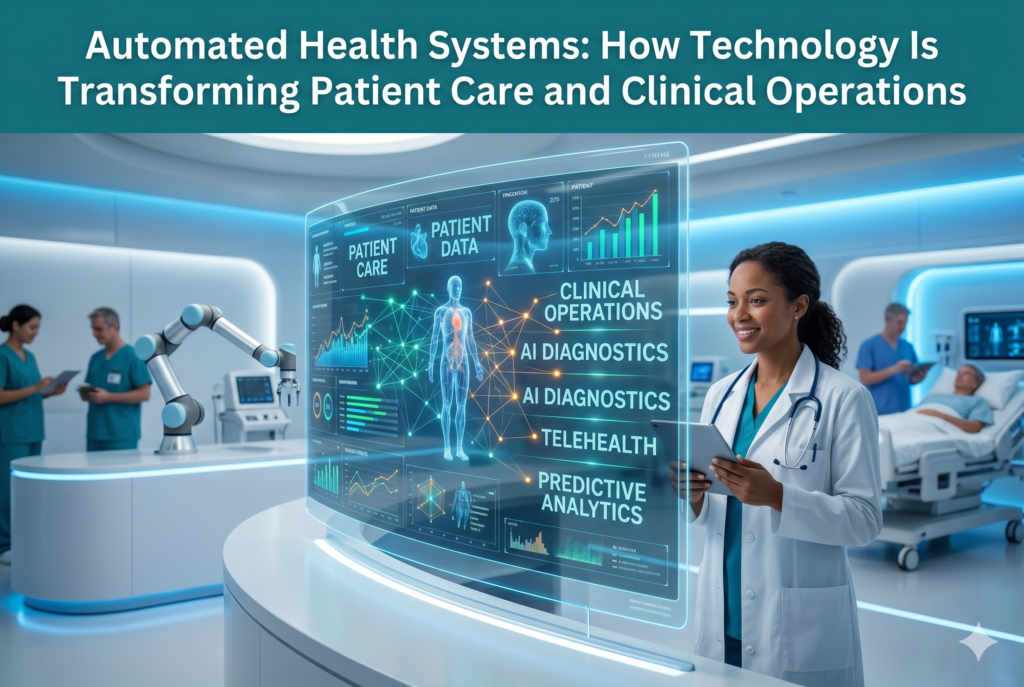
Healthcare is at an inflection point. The convergence of aging populations, chronic disease burdens, workforce shortages, and rising patient expectations is creating an environment where manual, disconnected operational processes are no longer sustainable. Automated health systems represent a foundational shift in how care is delivered, documented, managed, and improved, and organizations that understand how to deploy these technologies strategically will be positioned to deliver better outcomes at lower cost.
This guide covers the core categories of automated health systems, their clinical and operational applications, the governance required to implement them responsibly, and how they connect to the broader digital transformation that modern healthcare organizations must undertake.
Defining Automated Health Systems
Automated health systems encompass any technology that reduces or eliminates manual human intervention in a healthcare process while maintaining or improving the quality of the outcome. This definition is intentionally broad because automation in healthcare operates across a spectrum from simple workflow triggers to sophisticated AI-driven clinical decision support.
At the simpler end of the spectrum are rule-based automations: appointment reminders sent when a patient is overdue for a preventive care visit, alerts triggered when a lab value falls outside a defined range, or claims that are automatically validated and submitted when all required fields are complete.
At the more complex end are systems that analyze unstructured clinical data to identify patients at risk of deterioration, algorithms that optimize surgical scheduling based on hundreds of variables simultaneously, and AI tools that read diagnostic imaging and flag findings for physician review.
Both ends of this spectrum share a common purpose: removing friction, reducing variability, and freeing human clinical and administrative judgment for the decisions that genuinely require it.
Categories of Automated Health Systems
Clinical Decision Support Systems (CDSS)
Clinical decision support systems analyze patient data in real time and surface relevant guidance at the point of care. Examples include drug interaction alerts when a new medication is prescribed, sepsis early warning systems that monitor vital signs and lab trends, and order sets that prompt clinicians to follow evidence-based protocols for common conditions.
Well-designed CDSS significantly reduces preventable medical errors. Medication-related adverse events, for example, are among the most costly and harmful in acute care settings, and automated checks at the prescribing and dispensing steps catch a meaningful proportion of errors before they reach patients.
The challenge with CDSS is alert fatigue. When systems generate too many low-specificity alerts, clinicians begin overriding them reflexively, eroding the value of the automation. Effective CDSS implementation requires ongoing calibration to ensure that alerts are specific, actionable, and clinically meaningful.
Automated Medication Management
Pharmacy automation spans a range of technologies from robotic dispensing cabinets on nursing units to centralized robotic pharmacy systems that fill and label prescriptions with minimal human handling. These systems reduce dispensing errors, improve inventory management, and create auditable records of medication handling at every step from receipt to administration.
Automated dispensing cabinets at the point of care allow nurses to access medications securely without traveling to the central pharmacy, reducing medication administration delays particularly in critical care and emergency settings.
Laboratory and Diagnostic Automation
Clinical laboratories process enormous volumes of specimens with demanding accuracy requirements. Laboratory automation systems handle specimen sorting, routing, analysis, and result reporting with minimal manual handling. Automated analyzers run multiple assays simultaneously, flag abnormal results for technologist review, and integrate directly with the laboratory information system to report verified results to the ordering clinician.
Diagnostic imaging automation includes AI tools that assist radiologists by pre-reading studies, highlighting regions of concern, and quantifying findings. These tools do not replace radiologist judgment but improve the speed and consistency of image interpretation, particularly in high-volume screening programs.
Patient Engagement and Communication Automation
Automated patient communication systems manage outreach across the care continuum. Pre-visit messages deliver instructions and collect pre-registration information. Post-visit follow-up messages check on recovery, answer common questions, and route clinical concerns to care coordinators. Population health management platforms identify patients who are overdue for chronic disease management visits and initiate automated outreach to close care gaps.
These systems extend the reach of clinical teams beyond the walls of the facility, supporting the shift from episodic care to continuous care management that value-based payment models require.
Revenue Cycle Automation
Revenue cycle processes generate enormous administrative burden. Automated health systems address each phase of the revenue cycle, from eligibility verification before the visit to claims submission, payment posting, denial management, and patient billing after it. Automation in revenue cycle management reduces the cost to collect, shortens the time from service to payment, and improves the accuracy of financial data that leadership uses for planning.
The Role of Interoperability in Automated Health Systems
The effectiveness of automated health systems is directly proportional to the quality and completeness of the data they can access. A CDSS that only sees data from one EHR system cannot alert on lab results from a reference laboratory that uses a different platform. A population health management tool that lacks claims data will miss patients who received care at out-of-network facilities.
Interoperability standards such as HL7 FHIR (Fast Healthcare Interoperability Resources) are making it progressively easier to connect disparate systems and create the comprehensive, longitudinal data sets that sophisticated automation requires. Healthcare organizations that invest in interoperability infrastructure today are building the foundation for increasingly capable automation in the future.
Governance and Safety Considerations
Automation in healthcare carries higher stakes than in many other sectors. A billing error wastes money. A clinical automation error can harm a patient. Robust governance is not optional.
Validation and Testing
Every automated clinical system must undergo rigorous testing before deployment in a live environment. This includes not only functional testing to verify that the system does what it is designed to do but also testing for failure modes, edge cases, and interactions with other systems.
Ongoing Monitoring and Auditing
Automated systems should be monitored continuously for performance against defined metrics. Alert sensitivity and specificity for CDSS tools should be reviewed regularly. Dispensing accuracy rates for pharmacy automation should be tracked. Claims acceptance rates for revenue cycle automation should be benchmarked against baseline.
Clear Accountability
Automation does not diffuse accountability. For every automated clinical or administrative process, there must be a defined human responsible for its governance, monitoring, and performance. Technology does not make decisions in healthcare. It informs and executes them within boundaries set by accountable human professionals.
Connecting Automated Health Systems to Digital Transformation
Automated health systems do not exist in isolation. They are most effective when embedded in a broader digital transformation strategy that connects clinical, operational, and financial systems into a coherent data ecosystem.
Organizations at the beginning of this journey benefit from structured guidance on where to start and how to build a technology foundation that supports ongoing capability growth. Engaging with specialists in digital consulting and process automation helps healthcare organizations map their current state, define a future-state architecture, and prioritize the automation investments with the highest clinical and operational return.
For healthcare leaders evaluating technology partners, a technical consultation provides a structured opportunity to assess current systems, identify integration gaps, and develop a roadmap that is grounded in operational reality rather than vendor marketing. The efficiency accelerator framework is particularly valuable for identifying high-impact, short-cycle automation opportunities that deliver measurable results while longer-term strategic initiatives are being planned.
Organizations that want to understand how automation connects to patient-facing digital experiences should also explore how custom CRM automation services can unify patient data across communication, scheduling, and care coordination platforms, creating a longitudinal view of each patient that supports both clinical care and relationship management.
Key Success Factors for Automated Health System Implementation
Clinician and staff involvement from the earliest stages of design prevents the misalignment between automation logic and real-world workflows that undermines adoption. Frontline staff understand edge cases and exceptions that leadership and IT teams often miss.
Phased implementation allows the organization to learn and adjust before deploying automation at scale. Piloting a new automated process in a single department before enterprise rollout significantly reduces the risk of widespread disruption from unforeseen issues.
Training and change management are as important as the technology itself. Staff who understand why automation is being implemented, how it affects their specific role, and how to handle exceptions are far more likely to use the system correctly and support its ongoing success.
Data quality investment precedes automation investment. Automated systems amplify the quality of the data they receive. Organizations with poor data hygiene in their source systems will find that automation produces incorrect outputs faster and at higher volume than manual processes did.
Frequently Asked Questions About Automated Health Systems
Q1: What are the biggest risks of healthcare automation? The primary risks are clinical safety incidents caused by automation errors or misconfiguration, data security breaches affecting protected health information, alert fatigue that causes clinicians to ignore important warnings, and staff resistance that prevents effective adoption. All of these risks are manageable with proper governance, testing, and change management.
Q2: How does automation affect clinical staff roles? Automation removes repetitive, rules-based tasks from clinical staff, allowing them to spend more time on complex patient care, communication, and judgment-intensive decisions. Most healthcare organizations find that automation increases job satisfaction among clinical staff by reducing the burden of administrative work.
Q3: What is the first step in implementing automated health systems? The first step is a structured assessment of current workflows to identify which processes are highest in volume, most error-prone, and most clearly defined by rules. These characteristics make a process a strong candidate for automation. Beginning with a focused, well-scoped initial implementation builds organizational confidence before expanding to more complex applications.
Q4: How do automated health systems handle exceptions? Well-designed automated systems include explicit exception handling logic that routes unusual cases to a human reviewer rather than attempting to process them automatically. Defining how exceptions are handled is a critical part of the implementation design process.
Q5: What regulations govern automated health systems? Automated health systems must comply with HIPAA for data privacy and security, FDA regulations for certain clinical decision support software classified as medical devices, CMS conditions of participation for facility accreditation, and state-specific regulations governing clinical practice and pharmacy operations. The regulatory landscape is evolving, particularly around AI-based clinical tools, and ongoing compliance monitoring is essential.