
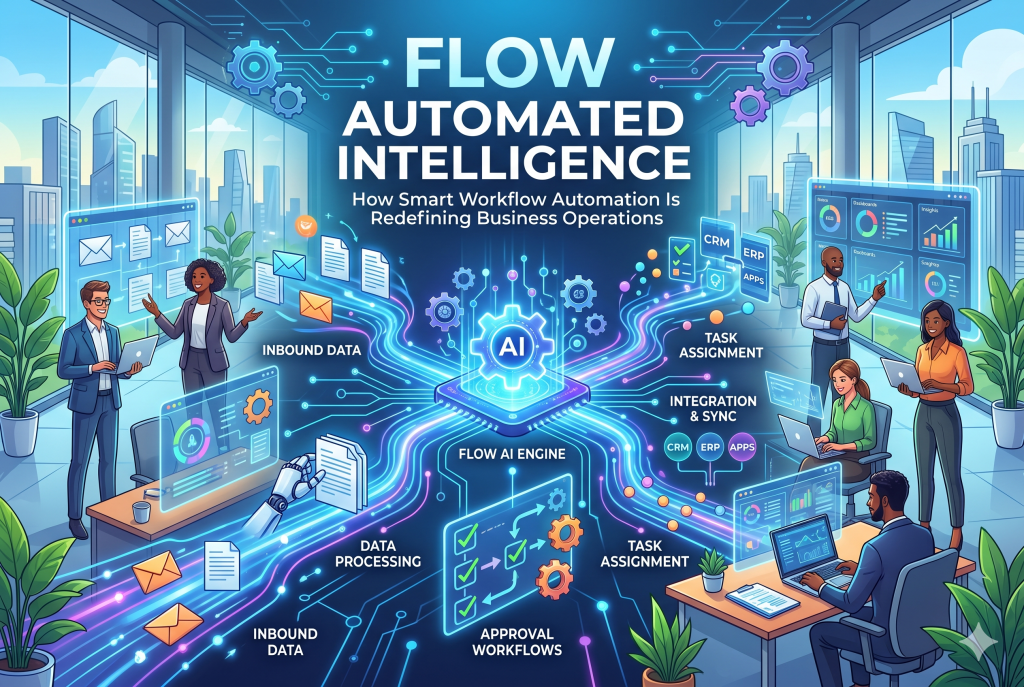
Flow automated intelligence represents the next evolution in how businesses design, execute, and optimize their operational workflows. Unlike traditional rule-based automation that follows rigid scripts, flow automated intelligence introduces adaptive, context-aware systems capable of learning from data, responding to exceptions, and continuously improving without constant human intervention.
As organizations grow more complex, the need for intelligent coordination between people, systems, and data becomes critical. Flow automated intelligence addresses exactly that challenge by combining the precision of automation with the adaptability of artificial intelligence.
What Is Flow Automated Intelligence
At its core, flow automated intelligence refers to the application of AI-driven logic within automated workflow systems. These systems do not simply execute predefined tasks. They evaluate inputs, make decisions based on learned patterns, route work to the appropriate team or system, and escalate exceptions when anomalies are detected.
Consider a document approval workflow. A traditional automated system might route every document to the same reviewer in the same order regardless of context. A flow automated intelligence system, by contrast, would assess the document type, identify the relevant stakeholder, check for compliance flags, and prioritize based on urgency before routing. The difference in efficiency and accuracy is significant.
This kind of intelligent orchestration is increasingly central to how modern companies deliver value. Organizations that invest in digital consulting and process automation are already using flow automation to reduce operational friction and eliminate bottlenecks that cost them hours every week.
The Architecture Behind Flow Automated Intelligence
Understanding how flow automated intelligence works requires a look at its underlying architecture. These systems typically consist of several interconnected layers:
Trigger Layer: Workflows are initiated based on events, schedules, or data conditions. This might be a form submission, a new row in a database, or an incoming email from a specific domain.
Processing Layer: Once triggered, the system applies intelligent logic. This is where AI models evaluate inputs, classify data, and make routing decisions. Natural language processing, computer vision, and predictive analytics can all play roles here depending on the complexity of the workflow.
Integration Layer: Flow automation systems connect to the tools and platforms a business already uses. CRM platforms, email systems, project management tools, and accounting software are all potential integration points.
Feedback Layer: Every completed workflow generates data. Intelligent systems capture this data, identify inefficiencies, and use it to refine future executions. This creates a continuous improvement loop that becomes more valuable over time.
Key Business Benefits of Flow Automated Intelligence
Organizations that adopt flow automated intelligence report measurable improvements across multiple operational dimensions.
Operational Speed: Tasks that once required multiple handoffs across departments can be completed in minutes rather than days. Automated routing eliminates the waiting time between steps.
Accuracy and Consistency: Human error is a significant cost driver in many businesses. When intelligent systems handle routine processing, error rates drop substantially. This is especially valuable in industries where compliance and data accuracy are critical.
Scalability: Flow automated intelligence allows businesses to handle volume growth without proportional increases in headcount. A well-designed automated workflow can process ten transactions as easily as ten thousand.
Employee Focus: When staff are freed from repetitive, low-value tasks, they can dedicate attention to work that genuinely requires human judgment, creativity, and relationship management.
For businesses looking to maximize these benefits, the business automation growth package offers a structured path to implementing intelligent workflows across core business functions.
Flow Automated Intelligence in Practice: Real-World Use Cases
The versatility of flow automated intelligence means it can be applied across virtually every industry and business function.
Sales and Lead Management: Intelligent workflows can score incoming leads based on behavioral data, route high-value prospects to senior sales staff, and automatically trigger nurturing sequences for leads that are not yet ready to convert. Companies using AI-powered lead generation and prospecting software are already seeing this in action, with significantly shorter sales cycles and higher conversion rates.
Finance and Accounting: Invoice processing, expense approval, and reconciliation workflows are prime candidates for flow automation. Intelligent systems can flag anomalies, cross-reference data across platforms, and generate alerts when something requires human review.
Customer Support: Flow automated intelligence enables smart ticket routing, automated resolution of common queries, and escalation protocols that ensure complex issues reach the right support staff immediately.
Human Resources: Onboarding workflows that coordinate IT provisioning, document signing, training assignments, and team introductions can be fully automated with intelligent orchestration, ensuring every new hire experiences a consistent and professional start.
Content and Marketing Operations: Campaign workflows, content approval chains, and distribution scheduling are all areas where intelligent automation reduces delay and ensures consistent brand execution.
How Flow Automated Intelligence Connects to Custom CRM Automation
One of the most impactful areas where flow automated intelligence delivers value is within customer relationship management. CRM systems are only as useful as the quality of data flowing through them and the speed at which that data is acted upon.
Intelligent workflows connected to a CRM can automatically update contact records when specific actions occur, trigger follow-up sequences based on deal stage changes, and generate activity reports without any manual input. The custom CRM automation services offered by modern digital agencies help businesses configure these intelligent flows so that their CRM becomes a living, responsive system rather than a static database.
When CRM automation is properly integrated with broader flow intelligent systems, sales teams gain visibility into every interaction touchpoint, leadership receives real-time pipeline intelligence, and customer communications become personalized at scale.
Selecting the Right Tools for Flow Automated Intelligence
The market for workflow automation platforms has grown considerably, and choosing the right foundation matters. Platforms like n8n, Zapier, Make, and Microsoft Power Automate each offer different levels of flexibility and AI integration.
For businesses with complex, custom requirements, building workflows on open-source platforms like n8n allows for deep customization and integration with proprietary systems. For teams looking for a faster path to deployment, no-code platforms provide accessible interfaces that enable non-technical staff to build and modify workflows.
The right choice depends on the scale of your operations, the technical capability of your team, and the depth of integration required with existing tools. A technical consultation with an experienced digital partner can help clarify which platform best fits your specific operational context.
Implementation Considerations and Common Pitfalls
Implementing flow automated intelligence successfully requires more than selecting the right software. Organizations often encounter predictable challenges during the implementation process.
Insufficient Process Documentation: Automation requires a clear understanding of the current workflow before it can be improved. Businesses that have not documented their existing processes will struggle to design effective automated alternatives.
Overcomplicating the Initial Build: A common mistake is attempting to automate too many exceptions and edge cases in the first version. Starting with the core happy path and iterating based on real performance data produces better outcomes than trying to anticipate every scenario upfront.
Neglecting Change Management: Staff who are accustomed to manual processes may resist automated systems, particularly if they perceive them as a threat to their roles. Clear communication about how automation supports rather than replaces their work is essential.
Poor Integration Planning: Flow automated intelligence systems depend on reliable connections between tools. Insufficient attention to authentication, data format compatibility, and error handling can cause cascading failures that undermine confidence in the system.
The Future of Flow Automated Intelligence
As large language models become more capable and more accessible, the sophistication of flow automated intelligence will increase dramatically. We are moving toward systems that can interpret unstructured inputs, generate dynamic workflow variations in response to changing conditions, and collaborate with human operators in conversational interfaces.
The organizations that invest in building intelligent workflow infrastructure today will hold a structural advantage as this technology matures. They will have clean data, tested processes, and experienced teams that understand how to extract value from increasingly powerful automation capabilities.
The efficiency accelerator programs designed for growing businesses reflect this forward-looking perspective, helping companies build automation foundations that are designed to scale with advancing AI capabilities rather than becoming obsolete as the technology evolves.
Frequently Asked Questions
What is the difference between flow automated intelligence and traditional automation?
Traditional automation executes predefined rules in a fixed sequence without the ability to adapt. Flow automated intelligence incorporates AI-driven decision logic that allows workflows to respond to context, learn from outcomes, and handle exceptions intelligently. The result is a more resilient and capable system that improves over time rather than requiring constant manual reprogramming.
Which business functions benefit most from flow automated intelligence?
Sales operations, customer support, finance and accounting, human resources, and marketing are the functions where flow automated intelligence typically delivers the most immediate value. These areas involve high volumes of repetitive tasks, structured data flows, and clear decision criteria that are well-suited to intelligent automation.
How long does it take to implement a flow automated intelligence system?
Implementation timelines vary based on complexity. Simple, single-function workflows can be deployed in a matter of days. Enterprise-grade systems that integrate multiple platforms and handle complex decision logic may take several months to design, test, and optimize. Starting with a focused use case and expanding iteratively is generally the most effective approach.
Do you need technical expertise to build flow automated intelligence workflows?
No-code and low-code platforms have made it possible for non-technical users to build functional automated workflows. However, more sophisticated systems that require custom integrations, advanced AI logic, or enterprise-grade reliability typically benefit from experienced technical implementation support.
What is the ROI of investing in flow automated intelligence?
Return on investment varies by industry and use case, but organizations commonly report reductions in processing time of 60 to 80 percent for automated functions, alongside meaningful reductions in error rates and overhead costs. The compounding effect of continuous improvement means that ROI tends to increase over time as the system learns and optimizes.